A low ceiling should not prevent you from building a capable home gym. The right power rack can provide a stable setup for squats, presses, pull-ups, and cable work while preserving valuable overhead clearance.
These 10 options cover folding wall-mounted racks, compact squat stands, adjustable cages, and pulley-equipped systems. Compare their height, mounting needs, capacity, attachments, and available training space before choosing.
Best 10 Power Rack for Low Ceilings Picks for 2026
Best Wall-Mounted Space Saver

- 85.8-inch height suits many lower-ceiling rooms
- Folds to a 19.7-inch open depth
- 1,000-pound capacity with included attachments
Best For: Wall-mounted home gyms prioritizing storage space
Best Compact Open-Frame Option

- 85.43-inch listed height
- Open frame supports squats, presses, and pull-ups
- Built-in storage and floor-anchor points
Best For: Freestanding home or garage gyms needing organization
Best Adjustable Half Rack

- 83-inch height for tighter overhead spaces
- 22 height settings and adjustable width
- 950-pound rating with extended safety arms
Best For: Lifters needing a versatile compact half rack
Best Multifunction Folding System

- Folding wall-mounted design saves floor space
- Dual pulley, pull-up, and landmine training
- 1,000-pound capacity with seven adjustable angles
Best For: Versatile home gyms wanting cable and barbell training
Compact Full-Height Pick
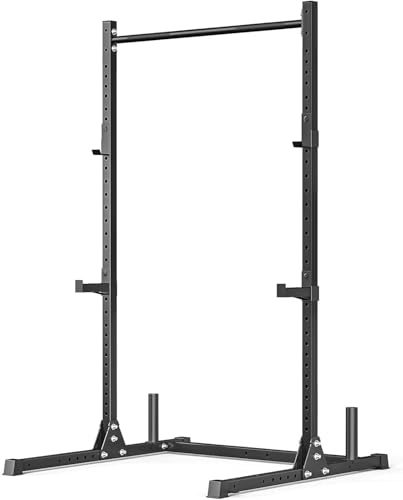
- 82-inch frame with 26 J-hook positions
- Rated for up to 800 pounds
- Includes multi-grip pull-up bar
Best For: Traditional barbell training in a compact home gym
Most Space-Saving System

- Folds to 4.3 square feet
- Five training configurations
- Dual independent pulley system
Best For: Small apartments, garages, and basements
Low-Ceiling-Friendly Option

- Only 58 inches tall
- Approximate 10.8-square-foot footprint
- Includes spotter arms and push-up handles
Best For: Low-ceiling rooms and compact barbell workouts
Best Overall

- 84.9-inch listed height
- 28 J-hook and spotter-arm positions
- Pulley system with integrated storage
Best For: Versatile home-gym training with substantial rack capacity
Best Equipped

- 82.6-inch listed cage height
- Pulley, lat-pulldown, dip, and landmine functions
- Extensive attachments and storage
Best For: Full-body training with many included accessories
Best Compact

- 79.7-inch listed cage height
- Covers about 12.5 square feet
- 2,000-pound listed maximum recommendation
Best For: Lower-ceiling rooms with limited floor space
Best Wall-Mounted Space Saver – Mikolo Folding Squat Rack
If ceiling height and floor space are limited, this folding wall-mounted rack is a practical power rack for low ceilings. Its 85.8-inch height, shallow 19.7-inch open depth, and fold-away design help preserve usable room around your training area.
Best For: Home gyms that need a wall-mounted rack with pull-up, barbell, and row-training capability.
Pros:
- Folds from a 19.7-inch-deep training position for easier storage.
- 2-by-2-inch, 13-gauge steel frame is rated for up to 1,000 pounds.
- Includes a pull-up bar, J-hooks with UHMW protection, safety catches, and a dual-size T-bar row attachment.
- Included stringer and metal studs support installation in about 15–30 minutes, according to the supplied details.
Cons:
- Requires suitable wall mounting and enough structural support for installation.
- Its 85.8-inch height may still be too tall for especially low ceilings.
- Wall-mounted use limits placement flexibility compared with a freestanding rack.
The Mikolo is a strong fit when folding storage matters as much as lifting capacity. Verify your ceiling height, wall construction, and mounting layout before purchase.
Best Compact Open-Frame Option – CAP Barbell Power Rack
With an 85.43-inch listed height and open-frame layout, this CAP Barbell model is worth considering as a power rack for low ceilings. It supports core barbell movements while adding storage and anchoring features for a more organized home or garage gym.
Best For: Lifters who want a compact, freestanding station for squats, presses, curls, pull-ups, and bodyweight work.
Pros:
- Open-frame design supports multiple strength exercises without a fully enclosed cage.
- Uses 12- and 14-gauge steel with welded seams and double-gusseted uprights.
- Includes an overhead pull-up bar and adjustable bar catches.
- Integrated bar and plate storage plus floor-anchor points help with organization and stability.
Cons:
- The supplied notes do not specify a maximum weight capacity.
- At 85.43 inches tall, it requires careful ceiling-height measurement.
- The listed warranty is 30 days, shorter than several competing rack warranties.
This CAP rack offers a straightforward freestanding setup with useful storage and anchoring points. Confirm the assembled height and available overhead clearance before committing to a low-ceiling room.
Best Adjustable Half Rack – FLYBIRD SR1 Squat Rack
The FLYBIRD SR1 is a compact half rack with an 83-inch height, making it one of the more ceiling-conscious choices in this power rack for low ceilings roundup. Its adjustable width and numerous height settings help accommodate different barbells and lifting positions.
Best For: Home-gym lifters who want adjustable barbell positioning, extended safety arms, and a compact footprint.
Pros:
- 83-inch height and compact footprint work well in many rooms, garages, and basements.
- 2-by-2-inch commercial-grade steel frame supports up to 950 pounds.
- Twenty-two height settings allow precise J-hook and safety-arm positioning.
- Includes 16.7-inch safety arms, a landmine, six resistance-band pegs, and a padded pull-up bar.
Cons:
- It is a squat rack only rather than a full power cage.
- The listed dimensions vary between the compact-footprint description and item dimensions, so confirm the required space.
- Compatibility is centered on 6-foot and 7-foot barbells.
For low ceilings, the SR1’s 83-inch height is a useful starting point, while its adjustment range adds versatility. Measure both ceiling clearance and barbell width before ordering.
Best Multifunction Folding System – Mdeam Folding Squat Rack
This Mdeam wall-mounted system combines a folding squat rack with dual pulleys, a pull-up bar, and a landmine. Its space-saving design and seven adjustable angles make it a flexible power rack for low ceilings, although the supplied details do not list its assembled height.
Best For: Home gyms seeking one wall-mounted station for barbell, cable, pull-up, and landmine exercises.
Pros:
- Folding construction helps reclaim space after training.
- Dual 1:1 cable pulley system supports independent crossover movements.
- 2-by-2-inch, 14-gauge steel frame is rated for up to 1,000 pounds.
- Includes a multi-grip pull-up bar, J-hooks, adjustable ground supports, and a 360-degree landmine.
Cons:
- The supplied notes do not provide an assembled height, so ceiling clearance must be confirmed.
- Wall mounting and ground-support setup require adequate installation space and structure.
- Its 151-pound package weight and larger component set may make installation more involved than a basic rack.
The Mdeam offers the broadest exercise selection here, but it is also the most equipment-heavy option. Confirm the height, wall structure, folding clearance, and cable-routing space before purchase.
Compact Full-Height Pick – Adjustable 800-LB Squat Rack
For shoppers seeking a power rack for low ceilings, this 82-inch-tall squat rack offers a relatively compact full-height option with adjustable J-hook positions and a built-in pull-up bar. Check your ceiling clearance carefully before assembling, especially if you plan to use the overhead bar.
Best For: Home gyms needing a traditional squat rack with pull-up and bench-training capability.
Pros:
- 26 J-hook adjustment positions support varied squat, curl, shrug, and bench setups.
- 2-by-2-inch, 13-gauge tubular steel frame is rated for up to 800 pounds.
- Triangular supports, anti-loosening nuts, and bolt holes are designed to improve stability.
- Multi-grip pull-up bar adds upper-body training options.
Cons:
- At 82 inches tall, it may not suit very low ceilings.
- Olympic bar and utility bench are not included.
- The 61-pound rack may require secure bolting for demanding loads.
This is a straightforward, adjustable cage for buyers who want conventional barbell training without a bulky commercial footprint. Its height is the key fit consideration for low-ceiling spaces.
Most Space-Saving System – Folding Cable Power Rack
This folding system is a strong contender for a power rack for low ceilings when floor space is also limited. It folds to 4.3 square feet and expands to 12.3 square feet, but buyers should verify the installation area and ceiling height before using the pull-up bar or other overhead functions.
Best For: Apartments, garages, and basements needing a multifunctional rack that stores compactly.
Pros:
- Folds for storage and supports five configurations, including half-rack and cable-crossover modes.
- Combines a rack, dual pulley system, pull-up bar, and functional trainer.
- Offers 15 pulley height adjustments and quick-swap accessories.
- Dual independent 1:1 pulleys support simultaneous cable exercises.
Cons:
- Wall mounting and folding clearance must be planned carefully.
- The supplied notes do not provide an assembled height.
- Its extensive cable functionality may be more than needed for basic squats and presses.
Among these options, this is the most focused on reclaiming floor space while preserving broad exercise variety. It is especially appealing where a rack must fold away, though ceiling and wall-clearance measurements are essential.
Low-Ceiling-Friendly Option – Adjustable 58-Inch Squat Rack
With a listed height of just 58 inches and a footprint of approximately 10.8 square feet, this adjustable rack is a practical power rack for low ceilings. Its compact, open design supports squats, bench presses, push-ups, and dips without adding a tall overhead structure.
Best For: Low-ceiling home gyms that prioritize a compact, adjustable barbell rack.
Pros:
- 58-inch height makes it easier to fit beneath low ceilings.
- Compact 36-by-43-inch footprint helps conserve floor space.
- Adjustable height accommodates different users and bar positions.
- Spotter arms, push-up handles, and dumbbell storage add versatility.
Cons:
- Its open squat-rack format does not provide a built-in pull-up bar.
- Bench and barbell are not listed among the included components.
- The stated 2,400-pound capacity includes different limits for lower and J-hook positions, so users should follow the specified ratings.
This is the clearest fit for genuinely low rooms because its listed height is substantially lower than a conventional cage. Choose it when compact barbell training matters more than overhead pull-up capability or a full enclosed rack.
Best Overall – SunHome Power Cage
For shoppers seeking a power rack for low ceilings, the SunHome Power Cage stands out with an 84.9-inch height and a broad range of rack adjustments. It combines barbell training, pull-ups, dips, and cable-style exercises in one home-gym frame.
Best For: Lifters who want a versatile rack with substantial load capacity and built-in storage.
Pros:
- Rated for up to 1,500 pounds on the power cage, according to the supplied product notes.
- Offers 28 adjustable positions for the J-hooks and spotter arms.
- Includes a pulley system, dip handles, and storage for weight plates and barbells.
- Its 84.9-inch listed height may suit some lower-ceiling workout spaces.
Cons:
- The 46.9-by-42.4-inch footprint may still require careful room planning.
- The supplied details list a one-year warranty.
The SunHome is a strong all-around choice when adjustability and storage matter. Before buying, measure your ceiling and allow additional clearance for exercises performed above the frame.
Best Equipped – Sportsroyals Power Rack
The Sportsroyals Power Rack is a fully equipped option for a power rack for low ceilings, with a listed cage height of 82.6 inches. Its pulley system and extensive attachment package support a wide range of strength exercises in one station.
Best For: Home gyms that prioritize exercise variety, cable training, and organized accessory storage.
Pros:
- The 82.6-inch cage height can be relevant for rooms with limited overhead clearance.
- Combines squat, lat-pulldown, dip, pull-up, landmine, and rowing functions.
- Includes 14 adjustable height levels and a broad selection of bars, handles, safety pieces, and attachments.
- Features multiple storage points for plates, handles, and a barbell.
Cons:
- Its 61.6-by-56-inch footprint is relatively large compared with the other listed options.
- Assembly is recommended for two or three people.
- The rack ships in two boxes that may arrive on different days.
Choose this model if maximum versatility is more important than a compact footprint. Its height is comparatively low, but the wide base and two-box assembly should be considered before ordering.
Best Compact – JELENS S11 Power Cage
The JELENS S11 is a compelling power rack for low ceilings because its compact design covers about 12.5 square feet and lists a cage height of 79.7 inches. It still includes adjustable pulley training, a lat pulldown, a landmine, and core rack attachments.
Best For: Lifters working with limited floor area and lower overhead clearance.
Pros:
- Its 79.7-inch listed cage height is the shortest among these three models.
- Compact 57.5-by-44.5-inch dimensions help conserve floor space.
- Supports squats, bench presses, pull-ups, seated rows, triceps extensions, and landmine work.
- Offers a listed 2,000-pound maximum weight recommendation and 13 marked height settings.
Cons:
- The compact frame may provide less surrounding room for certain exercises and equipment.
- The product ships in two boxes, which may arrive separately.
- The supplied details list a one-year warranty.
The S11 is the most space-conscious pick in this group, particularly for low-ceiling rooms. Confirm the actual ceiling height and overhead exercise clearance, since the listed cage height does not account for every movement or attachment.
How We Picked the Best Power Rack for Low Ceilings
We focused on the practical constraints that matter most in compact training spaces: overall rack height, usable bar clearance, footprint, installation requirements, weight capacity, adjustment range, and exercise versatility. Folding and wall-mounted designs received special consideration because they can free floor space when not in use.
We also compared whether each rack includes useful accessories such as J-hooks, pull-up bars, dip handles, pulley systems, lat pulldowns, or plate storage. A high stated capacity is helpful, but it does not replace secure anchoring, a level installation surface, and correctly rated hardware.
Quick Comparison
For the smallest rooms, start with folding or wall-mounted models such as the Mikolo, Mdeam, and WM3-V4 options. These can be a strong fit when floor space and storage flexibility matter most. The FLYBIRD and PASYOU racks are worth considering for simpler setups with adjustable bar heights and fewer integrated cable components.
If you want a broader home-gym station, the SunHome, SPORTSROYALS, and JELENS cages add pulley or lat-pulldown functionality. CAP Barbell offers a more modular approach, while the 800-pound adjustable cage targets buyers who want a conventional rack format without committing to a large commercial-style system.
Key Buying Factors for a Power Rack for Low Ceilings
Measure More Than the Rack Height
Measure from the floor to the lowest ceiling obstruction, then account for flooring, platform thickness, barbell diameter, and your own overhead reach. Pull-up bars and cable attachments may extend above the advertised frame height, so check the complete assembled dimensions.
Choose the Right Configuration
Folding wall racks save space, but they require solid wall structure and careful installation. Freestanding cages are easier to reposition but usually occupy more floor area. If you train with heavy loads, prioritize a rigid frame and dependable safeties over a minimal footprint.
Check Training Clearance and Adjustability
Low ceilings can restrict overhead presses, pull-ups, and lat-pulldown movements even when the rack itself fits. Look for multiple J-hook and safety positions, enough interior depth for squats, and pulley travel that does not force awkward positioning.
Verify Capacity and Compatibility
Confirm that the rack supports your barbell diameter, plates, attachments, and intended exercises. Capacity ratings may vary by component, so review the limits for the uprights, safeties, pull-up bar, pulley, and included hardware separately.
Who Should Buy Which Power Rack for Low Ceilings?
Choose a folding wall-mounted rack if you need to reclaim floor space between workouts and have a suitable wall for secure mounting. Choose a compact adjustable squat rack if your priority is basic barbell training with minimal equipment. Select a pulley-equipped power cage if you want one station for squats, presses, rows, pulldowns, and accessory work.
For heavier training or multiple users, favor a robust cage with clearly specified safeties and a generous adjustment range. Before ordering any Power Rack for Low Ceilings, confirm the assembled dimensions, mounting instructions, return policy, and the clearance required for every exercise you plan to perform.