A weighted vest can make easy runs, hill work, walking, and bodyweight training more demanding without requiring extra equipment. The right design should stay secure, distribute load evenly, and remain comfortable as your pace and distance increase.
We’ve gathered 10 adjustable options ranging from lightweight reflective vests to high-capacity models. Use the guide below to match weight range, fit, stability, and intended training style to your needs.
Best 10 Weighted Vest for Running Picks for 2026
Maximum Adjustability
RUNmax 20-150 lb Weighted Vest
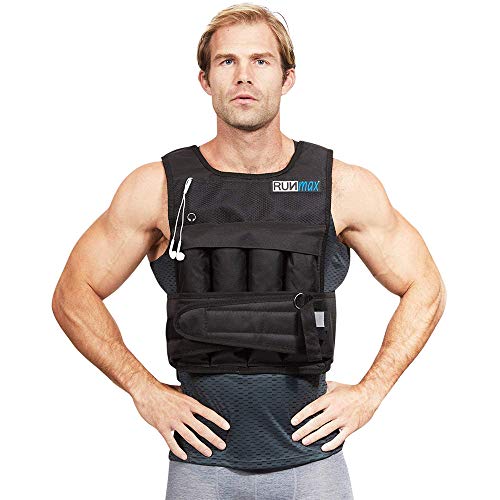
- Removable weights from 20 to 150 lb
- 28-48 in adjustable chest fit
- Mesh, reflectivity, and lifetime warranty
Best For: Progressive resistance and advanced training
Everyday Visibility

- 6-30 lb options with iron-sand filling
- 35-45 in adjustable chest range
- Reflective strips and storage pockets
Best For: Everyday running and general fitness
Heavy-Duty Loading

- 40 lb maximum capacity
- 4 lb adjustment increments
- Attached belt and one-piece design
Best For: Experienced users seeking heavier resistance
Balanced Comfort
Poudee Adjustable Weighted Vest

- 6-30 lb options with even iron-sand fill
- Breathable materials and adjustable straps
- Reflective detailing for outdoor workouts
Best For: Moderate running, walking, and bodyweight training
Best Progressive Fit

- Eight fixed weight options from 6 to 30 pounds
- Neoprene body with reinforced seams and padded shoulders
- Reflective stripe and adjustable buckle for outdoor workouts
Best For: Beginners and users progressing through different resistance levels
Best Adjustable Heavy-Duty Pick
APEXUP Adjustable Weighted Vest

- Removable 2.5-pound cast-iron blocks
- 20-, 30-, and 40-pound load options
- 1000D nylon with padded straps and waist belt
Best For: Experienced runners, ruckers, and strength-training users
Best Visibility for Mixed Workouts
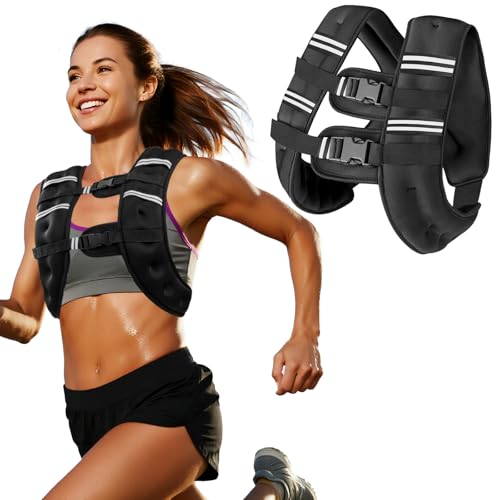
- Weight options from 6 to 30 pounds
- Front and back reflective strips
- Two adjustable elastic straps for fit flexibility
Best For: Mixed-workout users training outdoors in low-light conditions
Best with Extra Features
CAP 40 lb Adjustable Weighted Vest

- Adjusts from 2.5 to 40 pounds
- Padded shoulders and adjustable waist belt
- Reflective stripes for low-light visibility
Best For: Experienced users seeking high, adjustable resistance
Best Versatile Midweight Option
Poudee Adjustable Weighted Vest

- Weight options range from 6 to 30 pounds
- Even iron-sand weight distribution
- Adjustable, breathable design with reflective stripe
Best For: Runners who also hike, jog, walk, or strength train
Best 20 lb Progressive Pick
CAP 20 lb Adjustable Weighted Vest

- Adjusts from 1 to 20 pounds
- Uses 1-pound weight packets
- Reflective stripes and padded shoulders
Best For: Beginners and intermediate users building resistance gradually
Maximum Adjustability – RUNmax 20-150 lb Weighted Vest
RUNmax rf20nop Run Fast 12lb-140lb Weighted Vest (without Shoulder Pads, 20lb),Black
Check Price On AmazonThe RUNmax is a highly adjustable weighted vest for running and broader strength work, with removable weights that let you progress from 20 to 150 pounds. Its contoured fit, breathable mesh, and reflective strips make it suitable for structured outdoor or gym training.
Best For: Experienced users who want substantial, progressive resistance for running, calisthenics, CrossFit, or tactical-style training.
Pros:
- Removable weights support gradual progression from 20 to 150 pounds.
- Adjustable straps fit 28- to 48-inch chests and are designed for a secure fit.
- Breathable mesh, reflective strips, reinforced stitching, and a limited lifetime warranty add practical value.
Cons:
- The listed configuration weighs 20 pounds without shoulder pads.
- Its large capacity may be more than beginners need for running.
This is the most expandable option in the group, but runners should begin with a manageable load and prioritize a stable, comfortable fit before adding weight.
Everyday Visibility – ZELUS 16 lb Weighted Vest
The ZELUS is a practical weighted vest for running, jogging, and general fitness, with iron-sand filling and several available weight options. Its adjustable buckles, reflective strips, and storage pockets make it convenient for routine outdoor workouts.
Best For: Beginners and general fitness users seeking a moderate, multipurpose vest for running, walking, cardio, and strength training.
Pros:
- Available in weights from 6 to 30 pounds, including the listed 16-pound version.
- Adjustable buckles accommodate 35- to 45-inch chests.
- Reflective strips and rear mesh storage help with outdoor usability.
- Soft, wear-resistant spandex fabric is designed for repeated workouts.
Cons:
- The stated chest range is narrower than some adjustable vest designs.
- The weight is not described as removable within the vest itself.
With moderate loading and practical visibility features, the ZELUS is a straightforward choice for runners who also want one vest for varied fitness sessions.
Heavy-Duty Loading – RUNFast 40 lb Pro Vest
The RUNFast Pro is a 40-pound weighted vest for running and strength-focused conditioning. Its load adjusts in 4-pound increments, while the attached belt is intended to simplify setup and help secure the one-piece design.
Best For: Experienced fitness users who need heavier, incremental resistance for cross-training and strength workouts.
Pros:
- Adjusts in 4-pound increments up to 40 pounds.
- One-piece construction includes an attached belt for easier setup.
- Hook-and-loop closure supports adjustable fastening.
Cons:
- The 40-pound listed configuration may be excessive for newer runners.
- The supplied notes do not mention reflective details or breathable materials.
- Its one-size design may not provide an ideal fit for every runner.
This vest is better suited to users already accustomed to loaded training than to casual runners. Start with a lighter setting and confirm that the belt stays secure during movement.
Balanced Comfort – Poudee Adjustable Weighted Vest
The Poudee offers a moderate, flexible approach to using a weighted vest for running, walking, jogging, and strength training. Adjustable straps, breathable materials, reflective detailing, and evenly distributed iron sand are aimed at keeping the vest comfortable during varied workouts.
Best For: Men and women who want a versatile vest for moderate outdoor cardio and bodyweight training.
Pros:
- Available in weights from 6 to 30 pounds, including the listed 12-pound model.
- Evenly distributed iron sand is intended to minimize shifting and strain.
- Adjustable straps and breathable materials support mobility and comfort.
- Reflective detailing improves visibility during outdoor sessions.
Cons:
- The supplied notes identify the product as adjustable but do not specify a chest-size range.
- The available notes do not describe removable individual weights.
The Poudee is a sensible middle ground for runners who want moderate resistance without the very high capacity of the RUNmax or RUNFast models. Its even fill and reflective design are useful for regular outdoor training.
Best Progressive Fit – Zeerun Weighted Vest
If you want a flexible weighted vest for running, the Zeerun offers several fixed-weight options from 6 to 30 pounds. Its neoprene construction, padded shoulders, adjustable buckle, elastic band, and reflective stripe are designed for a snug fit during running, walking, and strength training.
Best For: Beginners and fitness users who want to increase resistance gradually across different workouts.
Pros:
- Available in eight weight options from 6 to 30 pounds.
- Neoprene material and double-stitched seams help improve comfort and durability.
- Adjustable buckle, elastic band, and thickened shoulder pads support a close, less-shaky fit.
- Reflective stripes add visibility for lower-light outdoor sessions.
Cons:
- Weights are selected as separate fixed options rather than adjusted with removable blocks.
- The listed 10-pound model weighs 10 pounds, so users should choose carefully when progressing.
The Zeerun is a practical entry point for progressive training, especially if you prefer a simple vest with multiple weight choices and comfort-focused fit features.
Best Adjustable Heavy-Duty Pick – APEXUP Adjustable Weighted Vest
For runners and ruckers seeking a heavier, adjustable weighted vest for running, the APEXUP uses removable 2.5-pound cast-iron blocks. It is offered in 20-, 30-, and 40-pound configurations and combines 1000D nylon, reinforced stitching, padded shoulder straps, and an adjustable waist belt.
Best For: Experienced users who want adjustable resistance for loaded runs, rucking, calisthenics, and strength training.
Pros:
- Removable 2.5-pound blocks allow the load to be changed as fitness progresses.
- Heavy-duty 1000D nylon and reinforced stitching are designed for demanding use.
- Padded shoulder straps and an adjustable waist belt help keep the vest secure with less shifting.
- Reflective strips improve visibility during early or late outdoor sessions.
Cons:
- Its 20- to 40-pound range may be excessive for beginners or casual runners.
- The supplied 40-pound configuration is listed at 20.05 kg, making it substantially heavier than lighter training vests.
The APEXUP stands out when adjustability and durability matter more than minimal weight. Its block-based design makes it better suited to structured progression and high-load training.
Best Visibility for Mixed Workouts – Zikopomi Weighted Vest
The Zikopomi is a versatile weighted vest for running with options from 6 to 30 pounds. Its neoprene-style construction, iron-sand filling, double-stitched design, two adjustable elastic straps, and front-and-back reflective strips support walking, running, cross-training, and strength workouts.
Best For: Men and women who want a multi-purpose vest with adjustable straps and added visibility for low-light exercise.
Pros:
- Available in seven weight options from 6 to 30 pounds.
- Iron-sand filling is designed for even weight distribution.
- Two adjustable elastic straps accommodate different body and chest shapes.
- Reflective strips on the front and back improve visibility during night running or riding.
Cons:
- The supplied notes mention a temporary new-product odor that may require one to two days of ventilation.
- Like the Zeerun, the weight options are fixed choices rather than a removable-weight system.
Zikopomi is a reasonable all-around option for users who value visibility and fit flexibility. Its broad exercise-use list makes it suitable beyond running, while the multiple weight choices support gradual selection.
Best with Extra Features – CAP 40 lb Adjustable Weighted Vest
If you want a weighted vest for running that can also support demanding strength and conditioning work, this 40-pound CAP model offers adjustable resistance from 2.5 to 40 pounds. Its padded shoulders, adjustable waist belt, reflective stripes, and reinforced construction make it a versatile option for progressive training.
Best For: Experienced users who want substantial, adjustable resistance for running, walking, cardio, and full-body workouts.
Pros:
- Adjusts from 2.5 to 40 pounds for progressive training.
- Padded shoulders and an adjustable waist belt help create a stable fit.
- Reflective stripes improve visibility during low-light walks or runs.
- Supports running, cardio, squats, lunges, push-ups, and other conditioning exercises.
Cons:
- The 40-pound configuration may be more resistance than beginners need.
- Its heavier design may feel less suitable for casual or shorter runs.
This is the most substantial option in the lineup, with removable 2.5-pound packets that let you build toward higher resistance. Choose it if adjustability and a high maximum load matter more than keeping your running setup lightweight.
Best Versatile Midweight Option – Poudee Adjustable Weighted Vest
For shoppers comparing a weighted vest for running with a more general workout vest, the Poudee model combines multiple weight choices with an adjustable fit. Even iron-sand distribution, breathable materials, adjustable straps, and a reflective stripe are designed to support comfortable movement across running, jogging, walking, hiking, and bodyweight training.
Best For: Men and women who want one adjustable vest for running and varied fitness activities.
Pros:
- Available in weight options from 6 to 30 pounds.
- Even iron-sand distribution is intended to minimize shifting and injury risk.
- Adjustable straps and breathable materials support mobility and comfort.
- Reflective detailing adds visibility for outdoor training.
Cons:
- The supplied specifications identify the 20-pound size, so buyers should confirm the selected configuration.
- The notes do not specify padded shoulder areas or a bounce-free fit.
The broad range of available sizes makes this a flexible pick for gradually increasing resistance or choosing a lighter setup for running. Its versatility is particularly useful if your routine includes more than just cardio.
Best 20 lb Progressive Pick – CAP 20 lb Adjustable Weighted Vest
This CAP vest is a practical weighted vest for running when you want adjustable resistance without starting at the heavier end of the range. It uses 1-pound packets and adjusts from 1 to 20 pounds, allowing you to increase the load gradually for cardio, walking, and full-body conditioning.
Best For: Beginners and intermediate users who want a manageable, adjustable vest for cardio and general workouts.
Pros:
- Adjusts from 1 to 20 pounds in 1-pound increments.
- Supports running, walking, cardio, push-ups, squats, lunges, and conditioning.
- Reflective stripes help with visibility in low-light environments.
- Designed with a waist belt and padded shoulders for a more stable fit.
Cons:
- Its 20-pound maximum offers less load than the 40-pound CAP model.
- The supplied details list a clip closure rather than the hook-and-loop closure noted for the 40-pound version.
With smaller weight increments and a 20-pound ceiling, this version is easier to tailor to a progressive running or conditioning routine. It is a sensible middle ground for users who do not need the heavier capacity of the larger CAP vest.
How We Picked the Best Weighted Vest for Running
We focused on the features that matter most when choosing a Weighted Vest for Running: adjustable load, secure fit, shoulder comfort, weight distribution, visibility, and versatility. The selected models cover lighter entry-level options as well as high-capacity vests for strength training and progressive overload.
Because running places repeated impact on your joints and torso, adjustability was especially important. A vest that lets you start light and add weight gradually is generally more useful than one designed around a single heavy load.
Quick Comparison
| Best For | What to Look For | Recommended Type |
|---|---|---|
| First-time users | Light starting weight and simple adjustment | 6–12 lb adjustable vest |
| Regular runners | Stable fit, balanced weight, and low movement | 12–30 lb adjustable vest |
| Strength-focused training | Broad capacity and durable construction | 40–150 lb plate- or pocket-loaded vest |
| Outdoor or early-morning workouts | Reflective details and secure closures | Reflective adjustable vest |
Key Buying Factors for a Weighted Vest for Running
Weight Range and Adjustability
Choose a vest that supports your current ability while leaving room for progression. Most runners should begin with a modest load, particularly when adding weight to faster runs, hills, or longer distances. Very heavy capacities are more appropriate for strength sessions, walking, or controlled conditioning than everyday road running.
Fit and Stability
The vest should sit close to your torso without restricting breathing. Adjustable straps or side panels help accommodate different body shapes and clothing layers. During movement, the load should not bounce, swing, or shift toward your neck and shoulders.
Comfort and Weight Distribution
Look for padded shoulder areas, breathable materials, and evenly distributed pockets or plates. A compact design can feel more stable, while a longer vest may spread pressure over more of your torso. Try short sessions first to identify rubbing or pressure points.
Visibility and Versatility
Reflective stripes are useful for roadside, dawn, and evening workouts. If you also perform squats, push-ups, step-ups, or walking workouts, prioritize a vest with removable weights and a secure fit across a range of movements.
Who Should Buy Which Weighted Vest for Running?
Beginners
Choose a lightweight adjustable vest and use it for walking or short easy sessions before attempting weighted runs. Gradual progression helps your muscles, connective tissue, and joints adapt.
Experienced Runners
Look for a streamlined, close-fitting model with enough adjustment to support occasional hill training and controlled conditioning. Stability matters more than maximum capacity.
Strength and Conditioning Users
A high-capacity RUNmax, CAP, or RUNFast-style vest may be more suitable if you want to add substantial resistance to bodyweight exercises. These models can be versatile, but their heavier loads may be excessive for regular running.
Safety-Minded Outdoor Users
Reflective models from brands such as ZELUS, Poudee, or Zikopomi can add visibility, provided the vest fits securely. Regardless of model, stop if you experience pain, altered running form, or excessive pressure on your shoulders or lower back.