The best binoculars for stargazing make the night sky feel more accessible, combining a wider field of view than most telescopes with simple, intuitive operation. The right pair can reveal lunar detail, star clusters, bright nebulae, and sweeping Milky Way fields.
This roundup includes compact handheld binoculars, wide-field models, and high-power astronomy binoculars that are better suited to tripod use. Use the guide below to match magnification, aperture, portability, and stability to the way you observe.
Best 10 Binoculars for Stargazing Picks for 2026
Deep-Sky Value

- 15x magnification with large 70mm objectives
- BaK-4 prisms for brighter low-light views
- Built-in tripod adapter and water-resistant armor
Best For: Stargazers seeking a tripod-ready balance of power and brightness
High-Power Explorer

- 20x magnification for distant details
- 70mm objectives with BAK4 and FMC optics
- Includes bag, cleaning cloth, and neck strap
Best For: Outdoor observers using one high-power binocular for multiple activities
Maximum Light Gatherer

- 20x power with large 80mm objectives
- BaK-4 prisms and multi-coated optics
- Tripod adaptable with 18mm eye relief
Best For: Deep-sky viewing from a stable, tripod-mounted setup
Portable All-Rounder

- 20x magnification in a compact design
- BAK4 prisms and multilayer-coated lenses
- Waterproof rubber-coated body with center focus
Best For: Casual stargazing and outdoor use where portability matters
High-Power Astronomy Pick

- 25x magnification with 70mm objectives
- BaK-4 prisms and multi-coated optics
- Tripod adapter included; tripod recommended
Best For: High-magnification astronomy and long-range viewing
Beginner Wide-Field Pick

- Wide 6.6-degree field of view
- Bright 50mm, multi-coated optics
- Lightweight and comfortable for handheld use
Best For: Beginner astronomy and broad-sky scanning
Wide-Field Stargazing Pick
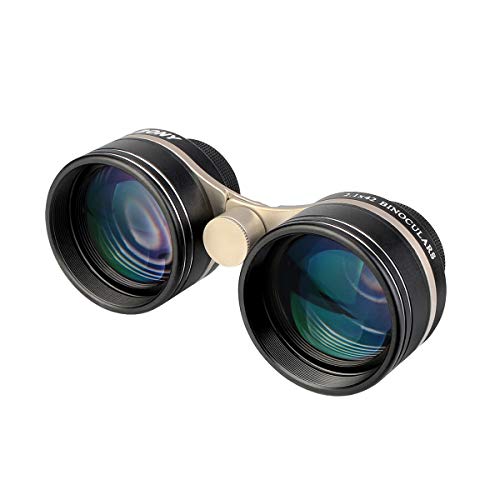
- 26-degree field captures complete constellations
- Fully multi-coated optics support brighter views
- Low 2.1x magnification is easy for broad sky scanning
Best For: Wide-field constellation viewing
Deep-Sky Powerhouse

- 100mm objectives gather substantial low-light detail
- 25x magnification suits distant and deep-sky viewing
- Requires a traditional photo tripod for stable use
Best For: Stationary deep-sky astronomy
Versatile Budget Option

- 50mm objectives support brighter low-light viewing
- 10x magnification works for astronomy and daytime use
- Water-resistant rubberized body improves handling
Best For: Entry-level backyard astronomy and general viewing
Deep-Sky Value – Celestron SkyMaster 15×70
For shoppers comparing binoculars for stargazing, the Celestron SkyMaster 15×70 combines strong magnification with large 70mm objectives designed to gather more light in dim conditions. Its BaK-4 prisms, water-resistant rubber armor, and built-in tripod adapter make it a practical choice for astronomy and long-distance viewing.
Best For: Stargazers who want bright night-sky views and plan to use a tripod.
Pros:
- 15x magnification and large 70mm objective lenses support detailed, low-light viewing.
- BaK-4 prisms help maximize light transmission for brighter images.
- Built-in 1/4″-20 adapter works with most traditional photo tripods.
- Includes water-resistant rubber armor and Celestron’s limited lifetime US warranty.
Cons:
- The large, heavy design is better suited to tripod use than handheld viewing.
- A tripod is not included.
The SkyMaster 15×70 is a balanced astronomy binocular for buyers who want substantial light-gathering ability without moving to the larger 80mm model. Plan for a stable mount to get the sharpest, most comfortable views.
High-Power Explorer – WOZEL 20×70
The WOZEL 20×70 is a versatile option for shoppers considering binoculars for stargazing alongside bird watching, hiking, travel, or sports. Its 20x magnification and 70mm objectives target distant details, while BaK4 prisms and fully multi-coated optics are intended to improve brightness and color reproduction.
Best For: Outdoor users who want high magnification for both astronomy and daytime activities.
Pros:
- 20x magnification helps reveal details on distant subjects.
- 70mm objectives support brighter viewing in low-light conditions.
- BAK4 prisms and FMC optics are designed for clarity and realistic color.
- Includes a carrying bag, cleaning cloth, and neck strap.
Cons:
- At about 2.8 pounds, it may be difficult to hold steadily for extended viewing.
- It is listed as not water resistant.
- Manual focus requires user adjustment.
This model offers impressive stated magnification and a broad range of uses, but its weight and lack of water resistance favor careful, stationary use. A stable support may help when viewing the night sky at 20x.
Maximum Light Gatherer – Celestron SkyMaster 20×80
For serious binoculars for stargazing, the Celestron SkyMaster 20×80 emphasizes light gathering with 80mm objectives and 20x magnification. Multi-coated optics, BaK-4 prisms, 18mm eye relief, and tripod compatibility make it especially suited to stable deep-sky observation.
Best For: Deep-sky observers who prioritize aperture and use a sturdy tripod.
Pros:
- Large 80mm objectives are designed for bright deep-sky views.
- 20x magnification supports detailed astronomical and long-distance viewing.
- BaK-4 prisms and multi-coated optics improve light throughput.
- Includes a tripod adapter, carrying case, lens cloth, caps, and rainguard.
Cons:
- The 4.8-pound body is too heavy for many handheld viewing sessions.
- A tripod is not included.
- Its giant Porro-prism design is less portable than compact binoculars.
The SkyMaster 20×80 is the aperture-focused choice in this group. It can deliver a more substantial astronomical viewing experience, but its size and weight make a stable mount an important part of the setup.
Portable All-Rounder – FLYA 20×50
The FLYA 20×50 offers a more portable approach to binoculars for stargazing, with 20x magnification in a compact body weighing about 0.89 kg. Its 50mm objectives, BAK4 Porro prisms, multilayer-coated lenses, and center focus make it suitable for casual astronomy as well as travel and outdoor observation.
Best For: Buyers who want high magnification in a relatively compact, waterproof binocular.
Pros:
- 20x magnification helps with distant targets and night-sky viewing.
- Multilayer-coated lenses and BAK4 prisms are designed to improve brightness and clarity.
- Compact, shock-resistant body has textured rubber grips.
- Waterproof construction is intended for outdoor conditions, though immersion is discouraged.
Cons:
- The 50mm objectives gather less light than the 70mm and 80mm alternatives.
- Its 2.5mm exit pupil may provide a less bright view in very dark conditions.
- Manual focus requires adjustment by the user.
This is the practical portability pick for shoppers who do not want giant astronomy binoculars. It trades some light-gathering capacity for a smaller body and broader everyday usefulness.
High-Power Astronomy Pick – Celestron SkyMaster 25×70
For shoppers comparing binoculars for stargazing, the Celestron SkyMaster 25×70 emphasizes long-range detail and light gathering with 25x magnification and large 70mm objectives. Its high power makes a tripod especially useful for steady astronomical viewing.
Best For: Experienced users who want high magnification for astronomy, wildlife, or long-distance terrestrial viewing.
Pros:
- 25x magnification and 70mm objective lenses provide detailed, long-range views.
- Multi-coated optics and BaK-4 prisms support brighter views in dim conditions.
- Built-in 1/4-inch-20 tripod adapter, water-resistant exterior, and limited lifetime warranty.
Cons:
- Its 1,474-gram weight and high magnification make tripod use advisable.
- The tripod is not included.
- Its 2.7-degree field of view is narrower than a wide-field beginner binocular.
The SkyMaster is a strong choice when magnification and reach matter more than portability. Plan on mounting it to a tripod for comfortable, shake-free sessions.
Feature-Rich Stargazing Kit – Sogries 18×70 Astronomy Binoculars
The Sogries 18×70 is a practical option for binoculars for stargazing when you want a large aperture, strong magnification, and accessories for stationary observation. It includes a tripod adapter and smartphone adapter for viewing and basic digiscoping.
Best For: Adults seeking a high-powered astronomy setup with smartphone capture capability and weather-resistant construction.
Pros:
- 18x magnification and 70mm objectives combine reach with substantial light-gathering capability.
- BAK-4 prisms and fully multi-coated lenses are designed for bright, high-contrast low-light views.
- Includes a tripod adapter and universal smartphone adapter, with IPX7 waterproof and fogproof construction.
Cons:
- At 4.7 pounds, it is heavy and best suited to tripod-mounted use.
- Manual focus and high magnification require careful setup for sharp, steady views.
- The included smartphone adapter fits phones within a specified width range, so compatibility should be checked.
This model stands out as an accessory-rich choice for moon tracking, star clusters, and long-distance viewing. Its weight favors a dedicated, tripod-based observing setup rather than casual handheld use.
Beginner Wide-Field Pick – Celestron Cometron 7×50
For beginners exploring binoculars for stargazing, the Celestron Cometron 7×50 offers an easy-to-handle design, bright views, and a wide field of view. Its 7x magnification is well suited to scanning constellations, the Milky Way, comets, and other large sky objects.
Best For: Beginners who want comfortable handheld astronomy binoculars that also work for birdwatching, hiking, and scenic viewing.
Pros:
- Wide 6.6-degree field of view helps users scan large portions of the sky.
- 50mm objectives, multi-coated optics, and a 7.1mm exit pupil support bright low-light views.
- Lightweight 774-gram design, carrying case, water-resistant construction, and limited lifetime warranty.
Cons:
- Lower 7x magnification provides less detail on small or distant objects than high-power models.
- The tripod adapter is not included.
- Individual focus may take more adjustment than a center-focus design.
The Cometron is a sensible entry point for learning the night sky because its wide view makes navigation straightforward. Choose it over a high-power model if handheld comfort and broad sky coverage are your priorities.
Wide-Field Stargazing Pick – SVBONY SV407 2.1x42mm
For viewers who want to take in broad star fields rather than zoom in on individual targets, the SVBONY SV407 is an unusual option among binoculars for stargazing. Its 2.1x magnification and exceptionally wide 26-degree field of view are designed for seeing complete constellations, while the fully multi-coated optics help make stars appear brighter and clearer than with the naked eye.
Best For: Observing entire constellations and wide star fields, with occasional use in theaters, exhibitions, or other low-light venues.
Pros:
- Extremely wide 26-degree field of view for viewing complete constellations.
- Fully multi-coated optics and a 42mm objective support bright, clear views.
- Long depth of field reduces the need for frequent focusing from near distances to infinity.
- Compact design includes a case, strap, lens covers, and cleaning cloth.
Cons:
- At 2.1x, it is intended for broad views rather than detailed deep-sky magnification.
- Independent eyepiece focusing requires separately aligning the left and right eyes.
- Its 9mm eye relief may be less accommodating for some eyeglass wearers.
The SV407 stands out for immersive, low-power sky scanning. Choose it when a sweeping view of constellations matters more than close-up lunar or deep-sky detail.
Deep-Sky Powerhouse – Celestron SkyMaster 25×100
The Celestron SkyMaster 25×100 is built for serious long-distance and deep-sky viewing. Its massive 100mm objectives gather substantial light, while 25x magnification brings distant celestial targets closer. Because of its 8.6-pound weight, this is a tripod-dependent choice among binoculars for stargazing rather than a handheld model.
Best For: Stationary backyard astronomy and low-light viewing of distant or deep-sky targets with a suitable tripod.
Pros:
- Large 100mm objective lenses are designed for bright, detailed low-light views.
- 25x magnification provides substantially more reach than standard binoculars.
- BaK-4 prisms maximize light throughput for night and dawn or dusk viewing.
- Built-in 1/4-inch-20 adapter attaches to most traditional photo tripods.
Cons:
- Its 8.6-pound weight makes tripod mounting essential for practical use.
- A tripod is recommended but is not included.
- The 3-degree field of view is narrower than wide-field astronomy binoculars.
This is the choice for users prioritizing aperture and magnification over portability. It can reveal more detail in dark-sky viewing, but its size and mounting requirements make it less convenient for casual, mobile observing.
Versatile Budget Option – Celestron UpClose G2 10×50
The Celestron UpClose G2 10×50 offers a practical balance for shoppers who want binoculars for stargazing without committing to a large astronomy setup. Its 50mm objectives and 10x magnification provide useful light gathering and reach, while the 6.8-degree field of view remains suitable for general sky scanning. It also works for wildlife, travel, events, and other daytime activities.
Best For: Beginners seeking one affordable, full-size pair for backyard astronomy and everyday outdoor viewing.
Pros:
- 50mm objectives and 5mm exit pupil support brighter low-light views.
- 10x magnification offers a useful increase over naked-eye viewing without extreme size.
- Multi-coated optics and BK-7 prism glass are designed for brighter, sharper, higher-contrast images.
- Rubber-covered body, water-resistant exterior, and included case improve practical usability.
Cons:
- BK-7 prisms and multi-coated optics are less specialized than premium astronomy optics.
- At 765g, it is full-size and may be tiring to hold for extended viewing.
- Its 6.8-degree view is narrower than dedicated wide-angle constellation binoculars.
The UpClose G2 is a sensible all-purpose starting point. It is best suited to casual astronomy and mixed outdoor use, rather than high-magnification deep-sky observation or expansive constellation viewing.
How We Picked the Best Binoculars for Stargazing
We focused on models with specifications that matter for night-sky viewing: objective-lens size, magnification, optical coatings, field of view, focusing design, and practical handling. The selection spans easy-to-hold 7×50 and 10×50 binoculars, wide-angle specialty models, and high-power 15×70 to 25×100 options for brighter deep-sky views.
Because high magnification can make handholding difficult, we also considered whether each style is better suited to casual handheld use or a tripod-mounted setup. Product descriptions and stated features were compared for intended use, aperture, and astronomy-focused design.
Quick Comparison
| Type | Typical Strength | Best For |
|---|---|---|
| 7×50 or 10×50 | Bright, stable, wide views | Beginners and casual handheld viewing |
| 15×70 or 18×70 | More reach with useful light gathering | Moon, clusters, and general astronomy |
| 20×70 or 25×70 | Higher detail and contrast | Experienced observers using support |
| 25×100 | Maximum aperture among these options | Deep-sky viewing from a fixed setup |
| 2.1×42 | Extremely wide field | Constellations and Milky Way scanning |
Key Buying Factors for Binoculars for Stargazing
Aperture and Light Gathering
The second number in a binocular specification is the objective diameter in millimeters. Larger objectives generally gather more light, helping faint stars and deep-sky objects appear brighter, but they also add weight. A 50mm model is a practical starting point; 70mm to 100mm models offer more brightness but usually need a tripod.
Magnification and Stability
Higher magnification shows more detail but narrows the field of view and magnifies hand shake. Models around 7x to 10x are easiest to use by hand. At 15x and above, a tripod adapter or supported viewing position is highly advisable.
Optics, Coatings, and Focus
Look for multi-coated or fully multi-coated optics and quality prisms, such as BAK-4, to improve light transmission and edge performance. Individual-focus systems can work well for astronomy, while center focus is more convenient when switching between sky and daytime targets.
Field of View and Portability
A wide field helps you locate constellations and scan star clouds, while a narrower field can make larger celestial targets easier to frame at high power. Also consider weight, carrying comfort, weather resistance, and whether your observing site requires frequent transport.
Who Should Buy Which Binoculars for Stargazing?
Beginners: Choose a 7×50 or 10×50 model for comfortable handheld viewing and a forgiving field of view.
Wide-field observers: A specialty low-power model is useful for sweeping constellations, following the Milky Way, and seeing large star fields.
Moon and deep-sky viewers: Consider 15×70 or 18×70 binoculars for a balance of reach and light gathering, preferably with tripod support.
Detail-focused observers: A 20×70 or 25×70 pair can reveal more lunar and deep-sky detail, but stability becomes essential.
Dedicated backyard astronomers: A 25×100 model provides the largest aperture in this selection and is best for a sturdy tripod or parallelogram mount. Before buying, confirm the required mount, storage space, and carrying weight.