Indoor cycling does not have to feel repetitive or disconnected from the road. The best smart bike rollers combine balance, adjustable resistance, quiet operation, and connected training features to make structured workouts more engaging.
Our roundup includes compact folding rollers, classic parabolic designs, and smart direct-drive trainers, so you can match your setup to your riding goals, available space, and preferred training platform.
Best 10 Smart Bike Rollers Picks for 2026
Best Value Stability
ROCKBROS Adjustable Bike Rollers

- Parabolic design enhances stability
- Foldable aluminum frame weighs about 6.5 kg
- Fits 16- to 29-inch bikes
Best For: Portable indoor training across multiple bike types
Best Adjustable Training
Elite Arion Mag Parabolic Rollers

- Three magnetic resistance levels
- Works with Rouvy and Kinomap
- Folds for compact storage
Best For: Structured workouts and interactive indoor sessions
Best Premium Frame
Wahoo KICKR ROLLR Indoor Trainer

- Carbon-steel construction
- Five listed settings
- 250-pound listed load capacity
Best For: Riders prioritizing a sturdy, adjustable trainer
Best No-Power Simplicity

- No power required
- Tapered rollers center wheels
- Folds for storage
Best For: Maintenance-free, straightforward indoor riding
Best Smart Trainer for Realistic Climbing

- 2,000-watt electromagnetic resistance
- Simulates gradients up to 18%
- ANT+ and Bluetooth compatible
Best For: Zwift riders seeking stable, quieter climbing workouts
Best Simple Rollers for Balance Practice

- No power required
- Tapered rollers center the wheels
- Folds for compact storage
Best For: Cyclists wanting maintenance-free roller training
Best High-Power Smart Trainer

- Up to 2,500 watts
- Simulates gradients up to 25%
- Direct drive with ±1% stated accuracy
Best For: Serious riders training on steep virtual climbs
Best All-Around Smart Bike Rollers
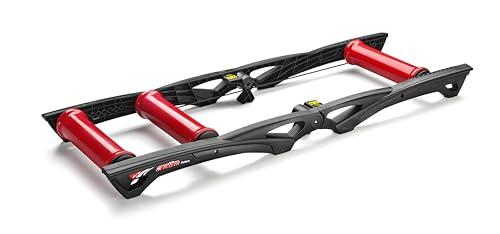
- App-compatible with Misuro B+ sensor
- Folds for convenient storage
- Supports road and mountain bikes
Best For: Portable connected training across multiple apps
Best for Travel and Track Work
Omnium Zero-Drive Portable Trainer

- Zero resistance for high-speed spinning
- Folds with included travel bag
- Fits 16- to 29-inch wheels
Best For: Track workouts, warm-ups, and traveling cyclists
Best for Stability and App Training
Elite Quick-Motion Roller Trainer

- Floating system promotes a realistic ride
- Three magnetic resistance levels
- Compatible with Kinomap and Rouvy
Best For: Stable, quiet indoor sessions with app support
Best Value Stability – ROCKBROS Adjustable Bike Rollers
For shoppers comparing smart bike rollers on a budget, the ROCKBROS trainer combines a parabolic design with magnetic resistance and a foldable aluminum frame. Its adjustable front wheel position supports 16- to 29-inch bikes, including MTB, road, and folding models.
Best For: Riders wanting a portable, space-saving roller setup with broad bike compatibility.
Pros:
- Parabolic rollers help enhance stability and keep the bike centered.
- Foldable aluminum frame weighs approximately 6.5 kg for easier storage and transport.
- Sealed bearings are designed for smoother operation.
- Fits 16- to 29-inch mountain, road, and folding bikes.
Cons:
- Offers one listed setting, providing less adjustment than multi-level models.
- Resistance is magnetic, but the notes do not specify app connectivity or electronic control.
This is a practical choice for indoor cycling beginners and anyone who values simple setup, stability, and convenient storage over advanced smart-training features.
Best Adjustable Training – Elite Arion Mag Parabolic Rollers
The Elite Arion Mag is a strong option among smart bike rollers for riders who want manually adjustable training intensity. Its three magnetic resistance levels, foldable frame, and compatibility with Rouvy and Kinomap support both structured workouts and interactive indoor sessions.
Best For: Cyclists seeking adjustable resistance and app-compatible roller training in a compact home setup.
Pros:
- Three manual magnetic resistance levels accommodate endurance, interval, and power workouts.
- Foldable design measures approximately 500 × 1400 × 130 mm for storage.
- Compatible with Rouvy and Kinomap for interactive sessions and performance tracking.
- Rated to generate up to 520 watts at 40 km/h.
Cons:
- Resistance changes are manual rather than automatically controlled by an app.
- The listed bike compatibility is limited to mountain and road bikes.
With more resistance control than a basic roller and stated app compatibility, the Arion Mag offers a balanced route into connected indoor training while retaining straightforward manual controls.
Best Premium Frame – Wahoo KICKR ROLLR Indoor Trainer
The Wahoo KICKR ROLLR is a substantial indoor trainer for cyclists prioritizing a carbon-steel construction and five listed settings. For shoppers evaluating smart bike rollers, it provides a heavier-duty format, though the supplied details do not specify app compatibility or additional connected features.
Best For: Riders who prefer a robust carbon-steel trainer with multiple settings.
Pros:
- Carbon-steel material and frame construction provide a sturdy design.
- Five listed settings offer more adjustment than single-setting roller models.
- Magnetic resistance supports indoor training without relying on a fluid mechanism.
- Supports a listed load capacity of 250 pounds.
Cons:
- At 25 kg, it is considerably heavier than lightweight foldable roller options.
- The supplied notes list mountain-bike compatibility only.
- No app compatibility or electronic training features are specified in the notes.
This model makes the most sense when frame solidity and adjustment range matter more than easy portability or clearly documented connected-training functions.
Best No-Power Simplicity – Garmin TacX Antares Rollers
The Garmin TacX Antares is a straightforward choice for smart bike rollers if you want retractable storage and no power requirement. Its tapered rollers help center the wheels, while the adjustable fit supports bikes with 26- to 29-inch wheel diameters.
Best For: Riders wanting maintenance-free rollers with simple, power-free operation.
Pros:
- Tapered rollers help keep wheels centered for added stability.
- Requires no power and is described as maintenance-free.
- Fits bikes with 26- to 29-inch wheel diameters.
- Folds to approximately 31.5 × 18.5 × 5.31 inches for storage.
Cons:
- The supplied notes do not specify app compatibility or connected-training features.
- Its maximum footprint expands to approximately 53 × 18.5 inches during use.
- No adjustable resistance levels are listed.
The Antares favors dependable simplicity over connected features, making it a sensible fit for riders who want easy storage and centered wheel tracking without plugging in a trainer.
Best Smart Trainer for Realistic Climbing – ThinkRider X2Max
The ThinkRider X2Max is a practical choice for cyclists comparing smart bike rollers and indoor trainers with app connectivity. Its ANT+ and Bluetooth support, 2,000-watt capacity, and simulated gradients up to 18% make it suitable for structured virtual rides, while the electromagnetic resistance system is designed for quiet indoor use.
Best For: Riders who want Zwift-compatible training with strong climbing simulation and a stable frame.
Pros:
- Supports both ANT+ and Bluetooth protocols and works with software such as Zwift.
- Provides up to 2,000 watts of power with a stated power-meter error of ±2%.
- Simulates gradients up to 18% and adjusts resistance through compatible riding software.
- I-beam triangular construction is designed for balance and stability, with noise around 58 dB at 30 km/h.
Cons:
- Cassette is not included.
- At 35.2 pounds, it is not the lightest indoor trainer to move and store.
The X2Max stands out when realistic incline changes, broad wireless compatibility, and stability matter more than a compact setup. Confirm that you have the required cassette before installation.
Best Simple Rollers for Balance Practice – Garmin TacX Antares Rollers
Garmin TacX Antares Indoor Retractable Bicycle Rollers 62 cm & TacX Rollable Trainer Mat
Check Price On AmazonThe Garmin TacX Antares is a straightforward option for cyclists browsing smart bike rollers but preferring a no-power roller setup. Its tapered rollers help keep the wheels centered, and the retractable frame accommodates 26- to 29-inch wheels while folding for easier storage. The included mat helps protect flooring and reduce riding noise.
Best For: Cyclists who want maintenance-free roller training, wheel-centering stability, and a foldable design.
Pros:
- Tapered rollers help keep the wheels centered for improved stability.
- Requires no power and is designed to be maintenance-free.
- Fits bicycles with 26- to 29-inch wheel diameters.
- Folds to 31.5 by 18.5 by 5.31 inches and includes a floor-protecting, noise-muffling mat.
Cons:
- It does not provide the connected power measurement or automatic virtual resistance associated with smart trainers.
- The listed load capacity is 40 pounds, so check suitability for your setup.
The Antares is best viewed as a simple, portable roller system rather than a fully connected smart trainer. Choose it for balance practice and uncomplicated indoor riding without a power adapter.
Best High-Power Smart Trainer – ThinkRider XXPRO
The ThinkRider XXPRO is built for demanding indoor sessions and is a strong contender among smart bike rollers and direct-drive trainers. It combines 2,500 watts of maximum power with gradient simulation up to 25%, plus ANT+, Bluetooth, virtual shifting, and downhill simulation for more immersive software-based training.
Best For: Serious indoor riders who want high-power climbing, downhill simulation, and flexible wired or self-powered operation.
Pros:
- Direct motor drive provides stated data accuracy of ±1% without calibration.
- Handles up to 2,500 watts and simulates gradients as steep as 25%.
- Supports Bluetooth, ANT+, bike GPS, PC connections, and the Zwift app.
- Can generate its own power and also includes a power adapter; downhill simulation adjusts to map slopes.
Cons:
- Its 19.49-inch length and 42-pound weight may make storage and transport less convenient.
- The supplied notes specify road-bike compatibility, so other bike types should be verified before purchase.
The XXPRO is the performance-focused option in this lineup, particularly for riders who want steep-gradient simulation and a high power ceiling. Its self-powering capability adds flexibility, while the included adapter supports plug-in use when preferred.
Best All-Around Smart Bike Rollers – Arion Roller Trainer
The Arion Roller Trainer is a practical choice for cyclists who want smart bike rollers with app compatibility and adjustable training potential. Its foldable composite design is easy to store, while pairing with the Misuro B+ sensor enables use with platforms such as Zwift, TrainerRoad, Kinomap, and My E-Training.
Best For: Riders seeking portable rollers with broad virtual-training compatibility.
Pros:
- Works with multiple training apps when paired with the Misuro B+ sensor.
- Folds down for more convenient storage and transport.
- Supports road and mountain bikes with wheels up to 29 inches.
- Provides up to 280 watts at 40 km/h for a challenging workout.
Cons:
- App connectivity requires the separately paired Misuro B+ sensor.
- Its plastic frame may be less substantial than an aluminum alternative.
Choose the Arion if you want a compact roller setup that can expand into connected indoor training. Its combination of folding storage, app support, and air resistance makes it versatile for regular workouts.
Best for Travel and Track Work – Omnium Zero-Drive Portable Trainer
The Omnium Zero-Drive is a strong option for cyclists prioritizing portability and high-speed spinning. These smart bike rollers use a zero-resistance design, fold into a compact platform, and include a travel bag for warm-ups, recovery sessions, and training away from home.
Best For: Track cyclists and traveling riders who want a lightweight, zero-resistance trainer.
Pros:
- Zero resistance suits high-speed spinning and track cycling.
- Folds compactly and includes a heavy-duty travel bag.
- Fits most 16- to 29-inch wheels with compatible fork adapters.
- Uses smooth, quiet 4.25-inch aluminum rollers and a maintenance-free design.
Cons:
- The resistance curve maxes out at approximately 150 watts.
- Its fork-mount design may be less suitable for riders wanting a conventional free-riding roller setup.
The Omnium stands out when transportability and cadence work matter more than high resistance. Its aluminum construction, travel case, and broad wheel compatibility make it especially useful for race-day preparation.
Best for Stability and App Training – Elite Quick-Motion Roller Trainer
The Elite Quick-Motion is designed for riders who want smart bike rollers with a more stable, realistic feel. Its floating system helps the bike move naturally, while three manually selected magnetic resistance levels and compatibility with Kinomap and Rouvy add training flexibility.
Best For: Indoor riders who value balance, quiet operation, and app-supported workouts.
Pros:
- Floating mechanism improves stability and riding feel.
- Three magnetic resistance levels accommodate warm-ups and harder sessions.
- Elastomer-coated rollers help reduce noise and vibration.
- Folds flat for storage and transport.
Cons:
- Resistance is adjusted manually rather than automatically.
- The supplied details list mountain-bike compatibility, so road-bike fit should be verified before purchase.
The Quick-Motion is a balanced pick for riders who want a quieter roller with basic resistance control and virtual-training support. Its fold-flat frame is particularly useful where storage space is limited.
How We Picked the Best Smart Bike Rollers
We compared these Smart Bike Rollers and related indoor trainers by looking at resistance control, connectivity, riding feel, stability, portability, setup requirements, noise, and compatibility with common road and mountain bikes. We also considered whether each model is better suited to casual fitness, balance practice, structured virtual workouts, travel, or serious performance training.
Because roller-style trainers and direct-drive smart trainers work differently, the list includes both categories. Traditional rollers emphasize balance and a natural, active riding feel, while smart trainers generally offer more precise resistance control and virtual training integration.
Quick Comparison
- Best for connected training: Smart trainers with ANT+ and Bluetooth support.
- Best for natural handling practice: Parabolic rollers that encourage smooth pedaling and balance.
- Best for small spaces: Foldable or retractable roller designs.
- Best for travel: Lightweight trainers with compact frames and carrying bags.
- Best for high-intensity workouts: Direct-drive models with substantial power and gradient simulation.
Key Buying Factors for Smart Bike Rollers
Resistance and Training Control
Basic rollers may rely on tire speed and optional resistance units, while smart trainers electronically adjust resistance for intervals, climbs, and virtual routes. If you plan to train with platforms such as Zwift or TrainerRoad, check that the trainer supports the required communication standards and workout control.
Bike and Drivetrain Compatibility
Traditional rollers usually accommodate a broad range of wheel sizes, but you should still confirm the adjustment range. Direct-drive trainers require removing the rear wheel and fitting the correct cassette, freehub body, axle standard, or adapter. Some models may not include a cassette, so budget for that separately.
Stability, Noise, and Space
Parabolic rollers can feel more forgiving for beginners, while compact trainers are easier to store. Consider frame rigidity, front-wheel support, floor clearance, and whether the unit folds or retracts. Tire type and pressure also affect noise and traction.
Connectivity and Power
ANT+ and Bluetooth expand device compatibility, but smart resistance features may require external power. Self-powered designs can be convenient, while plug-in units may provide more consistent performance during demanding sessions.
Who Should Buy Which Smart Bike Rollers?
Choose folding rollers if you want affordable indoor exercise, handling practice, and easy storage. Choose parabolic rollers if a smooth, natural ride and improved pedaling technique matter most. Choose a portable travel trainer if you regularly train away from home or need a lightweight solution.
Choose a smart direct-drive trainer if you want automatic resistance changes, accurate structured workouts, virtual gradients, and a more stable platform for hard intervals. Before buying, verify your bike’s drivetrain, axle, cassette requirements, room dimensions, and preferred training-app compatibility.