The best lightweight heart rate monitors make it easier to track effort without adding bulky equipment or distracting you during a workout. This roundup compares chest straps, armbands, fitness watches, and a compact ECG monitor for different training and health-tracking needs.
We focus on comfort, sensor accuracy, connectivity, battery life, water resistance, and device compatibility so you can choose a monitor that fits your routine.
Best 10 Lightweight Heart Rate Monitors Picks for 2026
Most Accurate

- Highly precise heart-rate measurement
- Bluetooth, ANT+, and 5 kHz connectivity
- Waterproof with 400-hour battery life
Best For: Athletes seeking accurate readings and broad device compatibility
Best Pocket EKG
KardiaMobile 1-Lead EKG Monitor

- Records a single-lead EKG in 30 seconds
- Weighs less than 1 ounce
- Detects several common rhythm results
Best For: Portable, occasional heart-rhythm checks and shareable readings
Best No-Phone Option

- Basic use does not require an app or phone
- Tracks heart rate, sleep, and daily activity
- Offers 5–7 days of battery and IP68 protection
Best For: Simple everyday fitness tracking with minimal setup
Best Armband Design

- Soft, breathable alternative to a chest strap
- Pairs with up to three Bluetooth devices
- 38 hours of operation per charge
Best For: Comfort-focused sports tracking with Bluetooth devices
Best Armband Pick

- Lightweight optical armband with adjustable placement
- Bluetooth and ANT+ connectivity
- Up to 24-hour battery with IP68 protection
Best For: Runners, gym users, and cyclists seeking a comfortable chest-strap alternative
Best Long-Value Pick
- Dual Bluetooth and ANT+ transmission
- Up to 300 hours from a CR2032 battery
- IP67 protection for sweat and rain
Best For: Cyclists and athletes using multiple compatible devices
Best Battery-Life Pick

- Up to 1,000 hours of advertised battery life
- ANT+ and Bluetooth simultaneous transmission
- IP67 dustproof and water-resistant design
Best For: Frequent trainers who want minimal battery maintenance
Top Dual-Protocol Chest Strap
COOSPO H808S Heart Rate Monitor
- 15 g chest-strap sensor with claimed ±1 BPM accuracy
- Bluetooth and ANT+ connectivity for multiple devices
- IP67 waterproofing and 300-hour replaceable battery
Best For: Runners, cyclists, and indoor-training users needing broad compatibility
Best Zone-Indicator Armband
C022Pro Optical Heart Rate Monitor

- Lightweight 12.2 g armband with washable elastic strap
- LED indicators show five heart-rate training zones
- Bluetooth and ANT+ connectivity with 30 m waterproof rating
Best For: Users wanting quick zone guidance from a comfortable armband
Best Battery Life
GEOID HS500 Heart Rate Monitor

- Up to 800 hours from a replaceable CR2032 battery
- ANT+ and Bluetooth support for apps and equipment
- IP67 rating with automatic wake-up when worn
Best For: Frequent trainees prioritizing long battery intervals
Most Accurate – Polar H10 Heart Rate Monitor
For shoppers comparing lightweight heart rate monitors, the Polar H10 stands out as a compact chest-strap sensor built around measurement accuracy and broad compatibility. It supports Bluetooth, ANT+, and 5 kHz connections, and can pair with multiple Bluetooth devices simultaneously.
Best For: Athletes who want highly accurate workout heart-rate data and flexible connections.
Pros:
- Recognized for top-level heart-rate measurement precision.
- Supports Bluetooth, ANT+, and 5 kHz connectivity.
- Waterproof and includes internal memory for multiple hours of data.
- Battery life is rated at approximately 400 hours.
Cons:
- Chest-strap design may be less convenient than a wrist or armband monitor.
- Uses a replaceable CR2025 button-cell battery rather than rechargeable power.
The Polar H10 is a strong pick when reliable readings and equipment compatibility matter more than having a screen or smartwatch-style features. Its included Pro strap is designed for comfort and a secure, interference-free fit.
Best Pocket EKG – KardiaMobile 1-Lead EKG Monitor
The KardiaMobile is one of the most portable lightweight heart rate monitors for checking heart rhythm away from home. This pocket-sized, FDA-cleared device records a single-lead EKG in about 30 seconds through a compatible smartphone or tablet.
Best For: Adults who want quick, portable heart-rhythm checks and shareable EKG results.
Pros:
- Weighs less than 1 ounce and fits easily in a pocket or bag.
- Records a single-lead EKG in approximately 30 seconds.
- Can identify normal sinus rhythm, AFib, tachycardia, and bradycardia.
- Works without a subscription for its core recording function.
Cons:
- Requires a compatible smartphone or tablet and the Kardia app.
- It is designed for spot EKG checks, not continuous workout monitoring.
- Additional rhythm features and doctor reviews require a paid KardiaCare subscription.
KardiaMobile is better suited to personal rhythm checks than exercise tracking. Its compact size, simple finger-contact operation, and ability to email recordings make it practical for communicating results with a healthcare professional.
Best No-Phone Option – LIVIKEY Fitness Tracker Watch
For a simple everyday option among lightweight heart rate monitors, this LIVIKEY fitness tracker watch provides heart-rate and sleep monitoring in a wrist-worn format. It can function like a regular watch without requiring app or smartphone setup for basic use, while also tracking steps, calories, distance, and selected sports.
Best For: Users who want straightforward daily activity and heart-rate tracking with minimal setup.
Pros:
- Basic fitness-tracker operation does not require an app or phone.
- Monitors heart rate and sleep, with nine sport modes.
- Tracks steps, calories, walking distance, and active time.
- Offers 5–7 days of use and an IP68 waterproof rating.
Cons:
- Advanced features such as goals and notifications require smartphone compatibility.
- GPS works through a smartphone rather than built-in GPS.
- Not compatible with tablets or computers.
This watch is a practical choice for casual monitoring and daily activity awareness rather than specialized training analysis. Its built-in display, long claimed battery duration, and no-phone basic operation keep the experience simple.
Best Armband Design – COROS Heart Rate Monitor
The COROS Heart Rate Monitor is a lightweight armband alternative to a traditional chest strap. Its breathable fabric band, automatic wear detection, and Bluetooth pairing make it well suited to sports sessions where a comfortable, low-distraction fit is important.
Best For: Sports users who prefer an armband and need simultaneous Bluetooth connections during workouts.
Pros:
- Soft, breathable band is designed for comfortable sports use.
- Can pair with up to three devices simultaneously over Bluetooth.
- Automatically powers on and off when it detects that it is being worn.
- Provides up to 38 hours of operation or 80 days of standby per charge.
Cons:
- Bluetooth only; it is not compatible with ANT+.
- The product is intended for sports and activities rather than daily heart-rate tracking.
- Charging requires the included cable; a Type-C adapter is not included.
The COROS armband is a compelling fit-focused option for training, especially for users already working within a Bluetooth-based setup. Its removable sensor makes band cleaning easier, while the large size fits arms from 9.4 to 16.9 inches.
Best Armband Pick – Scosche Rhythm+ 2.0
For shoppers comparing lightweight heart rate monitors, the Scosche Rhythm+ 2.0 is a comfortable armband alternative to a chest strap. Its optical sensor tracks real-time heart rate and connects through both Bluetooth and ANT+ to compatible watches, fitness equipment, apps, and phones.
Best For: Runners, gym users, and cyclists who want a lightweight, secure armband with HRV support.
Pros:
- Lightweight 2.82-ounce design with an adjustable, breathable fit for the forearm, bicep, or tricep
- Bluetooth and ANT+ connectivity works with platforms including Strava, Peloton, Wahoo, and Morpheus Training
- Offers up to 24 hours of battery life and IP68 water resistance
- HRV mode captures RR interval data for supported training, sleep, and stress apps
Cons:
- Its 24-hour battery life is shorter than that of some replaceable-battery chest straps
- Requires a compatible Bluetooth or ANT+ device or app for viewing data
The Rhythm+ 2.0 stands out when comfort and flexible placement matter more than maximum battery longevity. It is a practical choice for intense, sweat-heavy workouts and users who want access to both heart-rate and HRV data.
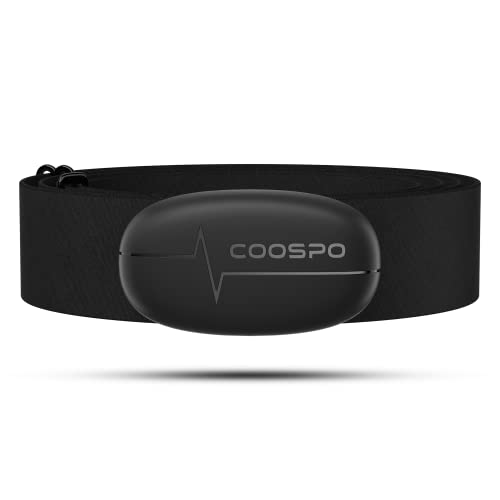
Best Long-Value Pick – COOSPO H6 Chest Strap
The COOSPO H6 is a lightweight heart rate monitor for users who prefer the close-to-chest positioning of a traditional strap. It provides real-time heart-rate data with Bluetooth and ANT+ transmission, supporting sports watches, bike computers, gym equipment, and popular fitness apps.
Best For: Cyclists and multi-device athletes who want long battery life and broad ANT+/Bluetooth compatibility.
Pros:
- Claims ±1 BPM heart-rate data for real-time workout monitoring
- Dual Bluetooth and ANT+ transmission supports compatible watches, bike computers, apps, and gym equipment
- Replaceable CR2032 battery provides up to 300 hours of use
- IP67 protection handles sweat and rainy-day training
Cons:
- Chest strap electrodes should be moistened before use for stable transmission
- Not intended for swimming or soaking
- Users need to separate the sensor from the strap after workouts
The H6 is a sensible pick if charging frequently is inconvenient. Its replaceable battery and wide device support suit regular training, though the chest strap requires more preparation and care than an armband.
Best Battery-Life Pick – Magene H64
The Magene H64 is a compact chest-strap option for shoppers seeking lightweight heart rate monitors with extended battery life. Its optimized hardware and algorithm are designed for reliable exercise readings, while ANT+ and Bluetooth allow simultaneous connection to compatible devices and apps.
Best For: Frequent cyclists, indoor trainers, and athletes who prioritize very long battery life.
Pros:
- Advertised battery life reaches up to 1,000 hours under stated test conditions
- ANT+ and Bluetooth can record data through a compatible device and app at the same time
- Works with bike computers, sports watches, fitness equipment, and apps such as Zwift, Strava, and Wahoo Fitness
- IP67 dustproof and water-resistant construction supports everyday training
Cons:
- Requires wetting the electrode area and placing the strap correctly for detection
- The phone’s system Bluetooth settings cannot be used for pairing; setup must be completed in the app
- Battery-life claims are based on laboratory testing and may vary in actual use
The H64 is especially appealing for athletes who want to minimize battery changes. Its simultaneous ANT+/Bluetooth support adds flexibility, but first-time setup requires following the included wearing and pairing instructions.
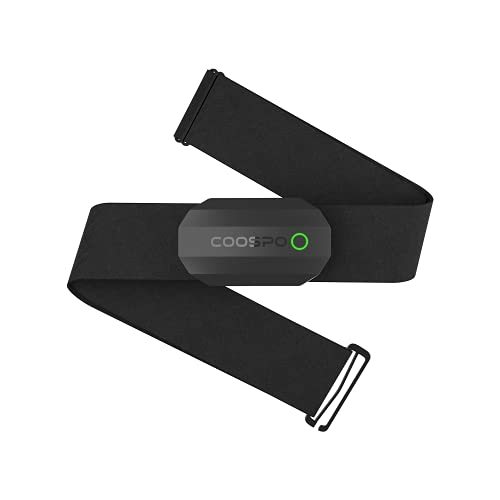
Top Dual-Protocol Chest Strap – COOSPO H808S Heart Rate Monitor
For athletes seeking lightweight heart rate monitors, the COOSPO H808S combines a 15 g chest-strap sensor with ±1 BPM accuracy, Bluetooth and ANT+ connectivity, and a replaceable-battery design. It can connect with compatible phones, watches, bike computers, and fitness apps, including Peloton, Strava, Wahoo Fitness, Polar Beat, and Zwift.
Best For: Runners, cyclists, and indoor-training users who need broad app and device compatibility.
Pros:
- Lightweight 15 g sensor with claimed ±1 BPM accuracy.
- Supports both Bluetooth 4.0 and ANT+ connections.
- IP67 waterproof rating and up to 300 hours of battery life.
- LED and beep reminders show connection status.
Cons:
- Requires moistening the electrode zones before use.
- The CR2032 battery and chest strap require periodic replacement.
The H808S is a practical choice when connectivity and low weight matter more than having an on-device display. Its replaceable battery and extensive third-party app support add convenience for regular training.
Best Zone-Indicator Armband – C022Pro Optical Heart Rate Monitor
The C022Pro is one of the more lightweight heart rate monitors for users who prefer an armband over a chest strap. Its 12.2 g optical sensor provides five heart-rate-zone LED indicators, while Bluetooth and ANT+ support lets it pair with phones, fitness equipment, watches, and bike computers.
Best For: Runners and gym users who want quick visual heart-rate-zone guidance from an armband.
Pros:
- Lightweight 12.2 g design with a washable elastic strap.
- Five LED zones indicate warm-up through maximum effort.
- Dual Bluetooth and ANT+ connectivity supports multiple device types.
- 30 m waterproof rating and four-channel optical sensing.
Cons:
- Supplied notes do not specify battery life.
- As an optical armband, fit and placement remain important for consistent readings.
The C022Pro stands out for its zone-focused feedback and low weight. It is a convenient option for training sessions where checking workout intensity quickly is more useful than viewing detailed data on the sensor itself.
Best Battery Life – GEOID HS500 Heart Rate Monitor
The GEOID HS500 is a lightweight chest-strap option for buyers prioritizing long service intervals. It uses ANT+ and Bluetooth, automatically wakes when worn, and offers up to 800 hours from a replaceable CR2032 battery. Its IP67 design is suited to activities such as running, cycling, football, and fitness.
Best For: Frequent trainees who want a chest-strap monitor with extended battery life and wide device support.
Pros:
- Up to 800 hours of battery life with a replaceable CR2032 cell.
- Supports ANT+ and Bluetooth connections across apps and fitness equipment.
- IP67 waterproof rating for many exercise conditions.
- Automatic wake-up and LED confirmation simplify setup.
Cons:
- Swimming is not recommended despite the IP67 rating.
- It uses a chest strap rather than an armband design.
Choose the HS500 if changing batteries frequently is a nuisance. Its long claimed runtime, automatic activation, and one-year limited warranty make it a sensible training companion for regular users.
How We Picked the Best Lightweight Heart Rate Monitors
We evaluated these Lightweight Heart Rate Monitors by looking at the features that matter most during everyday training: wearing comfort, measurement method, connectivity, battery life, water resistance, and compatibility with phones, watches, bike computers, and fitness apps. Chest straps generally provide consistent readings during exercise, while optical armbands and watches can be more convenient for users who dislike chest bands. The KardiaMobile device serves a different purpose, offering on-demand single-lead ECG readings rather than continuous workout tracking.
We also considered practical details such as automatic wear detection, ANT+ and Bluetooth support, replaceable or rechargeable batteries, and whether a monitor can work without carrying a phone.
Quick Comparison
- Best overall training choice: Polar H10, thanks to its broad compatibility and reliable chest-strap design.
- Best for ECG checks: KardiaMobile, designed for spot checks rather than workout tracking.
- Best for watch-free simplicity: The fitness tracker watch with standalone heart-rate and step tracking.
- Best armband options: COROS, Scosche Rhythm, and C022Pro for users who prefer an optical sensor on the upper arm.
- Best budget chest straps: COOSPO, Magene, and HS500 models with ANT+ and Bluetooth connectivity.
Key Buying Factors for Lightweight Heart Rate Monitors
Chest Strap Vs. Optical Sensor
Chest straps measure electrical signals and are often the better choice for intervals, cycling, and rapidly changing heart rates. Optical armbands and watches are easier to put on and may feel more comfortable for casual workouts, but fit, skin contact, movement, and tattoos can affect readings.
Compatibility and Connectivity
Check whether your preferred device supports Bluetooth, ANT+, or both. Dual-band monitors are the most flexible for pairing with phones, gym equipment, bike computers, and sports watches. A standalone watch may be preferable if you do not want to use an app or carry a phone.
Battery Life and Water Resistance
Frequent athletes should compare battery claims, charging or replacement-battery requirements, and water-resistance ratings. IP67 protection is useful for sweat and rain, while a waterproof sensor is a better fit for swimming-related use only when the manufacturer explicitly supports it.
Comfort and Fit
Look for an adjustable strap, soft materials, secure sensor placement, and a low-profile design. The lightest monitor is not always the most comfortable if it shifts during movement or requires excessive tightening.
Who Should Buy Which Lightweight Heart Rate Monitors?
Choose the Polar H10 if training accuracy and wide device compatibility are your priorities. Select a COROS, Scosche Rhythm, or C022Pro armband if you want to avoid a chest strap while still pairing with workout equipment and apps. The COOSPO H6, COOSPO H808S, Magene H64, or HS500 makes sense for shoppers seeking an affordable ANT+/Bluetooth chest sensor with long battery life.
Pick the standalone fitness tracker watch for basic heart-rate and step tracking without relying on a phone. Choose KardiaMobile when you specifically need portable ECG spot checks; it is not a substitute for a continuous exercise heart-rate monitor or professional medical evaluation.