The best bike computers make it easier to track rides, follow routes, monitor training data, and stay focused on the road. The right choice depends on whether you want simple speed and distance readings or advanced GPS navigation and performance tools.
We compared 10 notable options across Garmin, Wahoo, CATEYE, iGPSPORT, and COOSPO to help match features, controls, battery life, and price with different riding styles.
Best 10 Bike Computers Picks for 2026
Performance Navigator

- Multi-band GPS and advanced navigation
- Adaptive coaching with compatible sensors
- Up to 26 hours of demanding-use battery life
Best For: Training-focused cyclists needing detailed navigation
Simple Wireless Tracker
CATEYE Padrone Wireless Bike Computer

- Oversized display for core ride metrics
- Wireless speed sensor needs no pairing
- Tool-free FlexTight handlebar mount
Best For: Casual riders wanting simple speed and distance tracking
Easy Route Explorer

- 3-inch sunlight-readable touchscreen
- Preloaded road, trail, and eBike maps
- Smartphone and eBike connectivity features
Best For: Recreational, touring, and eBike navigation
Beginner Ride Meter
CATEYE Velo 7 Wired Bike Computer

- Tracks speed, distance, time, pace, and clock
- Automatic stop detection for traffic and breaks
- Battery life rated up to three years
Best For: Beginner cyclists wanting simple wired ride data
Premium Choice

- Large 3.5-inch vivid touchscreen
- Advanced training and navigation features
- Built-in speaker and group-ride tools
Best For: Feature-focused riders and connected group rides
Best Value Features
- Offline maps with turn prompts
- 130-plus riding data fields
- ANT+ and Bluetooth compatibility
Best For: Navigation-focused road, MTB, and e-bike riders
Best Compact Training Pick
- Compact 2.6-inch cycling computer
- Touchscreen and button controls
- Multi-band GNSS and adaptive training
Best For: Training-focused riders who prefer a compact computer
Best for Turn-by-Turn Navigation

- On-device turn-by-turn route guidance
- Automatic route downloads and workout uploads
- ANT+ radar, LiveTrack, and smart notifications
Best For: Connected navigation and training rides
Best for Color Touchscreen Training

- 2.4-inch color touchscreen with auto-backlight
- Built-in route navigation and customizable dashboards
- 36-hour battery with broad ANT+/Bluetooth connectivity
Best For: Detailed training data and visual controls
Best for Long Battery Life

- Up to 40 hours of battery life
- 2.6-inch anti-glare display with 40+ metrics
- Five-satellite positioning and ANT+/Bluetooth support
Best For: Endurance rides and essential ride tracking
Performance Navigator – Garmin Edge 540
For riders who want advanced bike computers with training guidance and detailed navigation, the Garmin Edge 540 combines button controls with GPS performance tools. Its multi-band GNSS, ClimbPro features, and long battery life make it suited to structured rides and challenging routes.
Best For: Training-focused cyclists who want advanced navigation and performance analysis.
Pros:
- Multi-band GNSS helps improve positioning accuracy in challenging environments.
- Provides adaptive coaching, suggested workouts, and training prompts when paired with compatible sensors.
- Offers up to 26 hours of battery life in demanding use, or up to 42 hours in battery-saver mode.
- Button controls can be practical when riding with gloves or in wet conditions.
Cons:
- Many training features require compatible power and heart-rate sensors.
- Its 2.6-inch screen is smaller than touchscreen-focused cycling computers.
- Advanced features may be more than casual riders need.
The Edge 540 is a strong choice for cyclists who want a compact, training-oriented bike computer with detailed route tools and dependable battery endurance.
Simple Wireless Tracker – CATEYE Padrone Wireless Bike Computer
The CATEYE Padrone is one of the more straightforward bike computers for riders who want essential ride data without GPS complexity. Its oversized display, wireless speed sensor, and automatic stop detection keep everyday tracking simple.
Best For: Casual and fitness riders who need clear speed, distance, and time readings.
Pros:
- Large display shows current, maximum, and average speed, plus distance, elapsed time, and clock.
- Wireless sensor setup avoids a wired connection between the wheel and computer.
- ClickTec design makes it easy to switch functions while riding.
- FlexTight mount installs and adjusts without tools.
Cons:
- Does not provide GPS, navigation, heart-rate data, or smartphone connectivity.
- The wireless sensor is intended for front-wheel use and has a 70-centimeter transmission range.
- Its feature set is limited for structured training or route planning.
Choose the Padrone when you value readability and uncomplicated operation more than mapping or connected features. It covers the core metrics most recreational riders use.
Easy Route Explorer – Garmin Edge Explore 2
The Garmin Edge Explore 2 is a practical option among bike computers for riders who prioritize route guidance and a simple touchscreen experience. Its 3-inch display, preloaded maps, and cycling-specific routing support road, off-road, indoor, and compatible eBike use.
Best For: Touring, recreational, and eBike riders who want accessible GPS navigation.
Pros:
- Glove- and rain-friendly touchscreen is designed to remain visible in direct sunlight.
- Preloaded maps highlight popular roads, trails, points of interest, and eBike routes.
- Compatible eBikes can provide battery, assist-level, and range-related navigation information.
- Smartphone pairing enables LiveTrack, GroupTrack, notifications, messaging, and incident detection during outdoor rides.
Cons:
- Battery life is listed at up to 16 hours, shorter than some training-focused models.
- Heart-rate, speed, and cadence monitoring require separately sold sensors.
- Its navigation-first design may not suit riders seeking extensive performance coaching.
With its approachable interface and route-focused features, the Edge Explore 2 is a good fit for cyclists who want to explore confidently without managing a highly technical training computer.
Beginner Ride Meter – CATEYE Velo 7 Wired Bike Computer
The CATEYE Velo 7 is a basic wired choice among bike computers, delivering the essential numbers beginners often want without GPS setup or complicated menus. It tracks speed, distance, ride time, pace direction, and clock information, with automatic stop detection for everyday rides.
Best For: Beginner cyclists riding road, mountain, or gravel bikes who want simple ride tracking.
Pros:
- Displays current, maximum, and average speed along with trip and total distance.
- Automatic start/stop pauses time and average-speed calculations when you stop.
- Battery life is listed at up to three years.
- Entry-level design supports straightforward installation and use.
Cons:
- Wired connectivity is less tidy than a wireless or GPS setup.
- Does not include GPS navigation or advanced connected features.
- Its 2.17-inch display is smaller than the Padrone’s oversized screen.
The Velo 7 is a sensible starting point for riders who want measurable progress without paying for features they may not use. Its long battery life and simple readouts keep the focus on riding.
Premium Choice – Garmin Edge 1050
The Garmin Edge 1050 is a premium option among bike computers, pairing a large 3.5-inch color touchscreen with detailed navigation, advanced training metrics, and connected-ride features. Its built-in speaker adds audible prompts and a bike-bell function, while battery life reaches up to 20 hours in demanding use or 60 hours in battery-saver mode.
Best For: Riders who want a feature-rich cycling computer for navigation, training, group rides, and road-awareness tools.
Pros:
- Vivid touchscreen supports on-device course creation and map planning.
- Provides advanced tools such as ClimbPro, power guidance, stamina insights, and adaptive coaching with compatible sensors.
- Includes road-hazard alerts, group-ride messaging, live locations, incident alerts, and Garmin Pay support.
- Built-in speaker provides workout and navigation prompts plus a bike-bell function.
Cons:
- Many training features require compatible power and heart-rate sensors.
- Some connected features require a compatible smartphone and Garmin Connect.
- Its extensive feature set may be more than casual riders need.
The Edge 1050 stands out when you want a large, vivid display and an unusually broad set of navigation, training, safety, and group-riding capabilities. It is best suited to cyclists who will actively use those advanced tools.
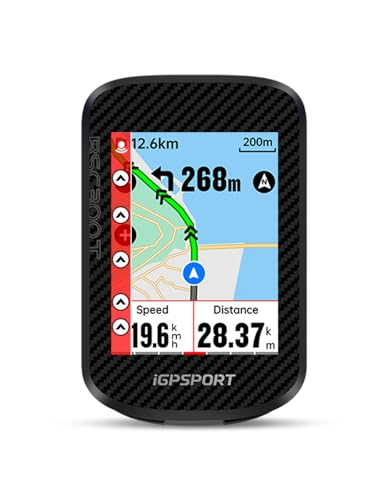
Best Value Features – iGPSPORT BSC300T
The iGPSPORT BSC300T packs practical navigation and tracking features into a bike computer with a 2.4-inch touchscreen and six buttons. It supports offline maps, route guidance, off-course warnings, real-time group tracking, and more than 130 riding metrics, with up to 20 hours of battery life.
Best For: Road, mountain, and e-bike riders who want offline navigation, broad sensor compatibility, and detailed ride data.
Pros:
- Supports worldwide offline map downloads, route previews, turn prompts, and off-course warnings.
- Offers more than 130 data fields, including speed, distance, grade, cadence, calories, and temperature.
- Works with ANT+ and Bluetooth devices such as sensors, e-bikes, and smart trainers.
- Supports real-time teammate tracking and sharing through the iGPSPORT app, Strava, and Komoot.
Cons:
- Battery life is listed at up to 20 hours, shorter than some options in this roundup.
- A Type-C cable is not included.
- The 2.4-inch display is smaller than the Edge 1050’s screen.
The BSC300T is a versatile choice for riders who prioritize mapping, data variety, and device compatibility. Its combination of touchscreen and physical buttons also gives you flexible control while riding.
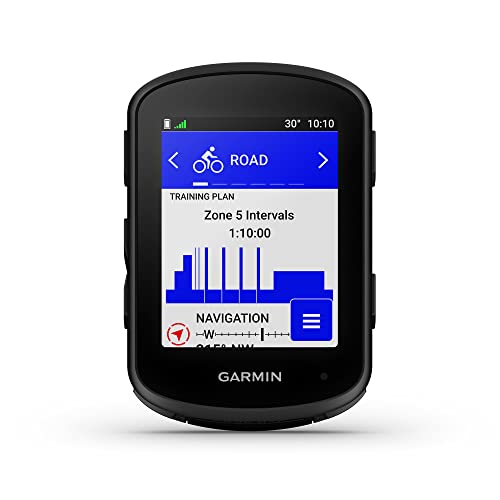
Best Compact Training Pick – Garmin Edge 840
The Garmin Edge 840 is a compact bike computer designed for riders who want serious training and navigation features without a large display. It combines touchscreen and button controls, multi-band GNSS, ride-type-specific maps, and personalized workout guidance, with up to 26 hours of battery life in demanding use.
Best For: Training-oriented cyclists who want a compact device with reliable positioning, climbing tools, and adaptive coaching.
Pros:
- Offers both touchscreen and button control for flexible operation.
- Multi-band GNSS is designed to improve positioning accuracy in challenging environments.
- Includes ClimbPro, stamina insights, power guidance, and adaptive training features with compatible sensors.
- Provides ride-type-specific maps with popular roads, trails, and searchable points of interest.
Cons:
- Several performance features require compatible power and heart-rate monitors.
- Its 2.6-inch display is smaller than the Edge 1050’s 3.5-inch screen.
- It does not list the Edge 1050’s built-in speaker and road-hazard features.
The Edge 840 is a strong middle ground for cyclists who value training depth and navigation while preferring a smaller form factor. Its dual-control design and long battery life make it practical for structured rides and longer outings.
Best for Turn-by-Turn Navigation – Wahoo ELEMNT BOLT V3
The Wahoo ELEMNT BOLT V3 is one of the more navigation-focused bike computers in this roundup. It provides on-device turn-by-turn prompts, automatic route downloads, and live route generation, while its compact 2.3-inch display and 20-hour battery suit regular road rides and training sessions.
Best For: Riders who prioritize dependable route guidance, connected training services, and radar integration.
Pros:
- Generates turn-by-turn directions from GPX, TCX, Strava, Ride with GPS, and Komoot routes.
- Supports on-demand route creation from the device or companion app.
- Works with ANT+ rearview radar and provides smart notifications and LiveTrack.
- IPX7 water resistance and up to 20 hours of battery life.
Cons:
- The 2.3-inch LCD is smaller than the displays on the other listed options.
- Several connected features require a paired smartphone or compatible accounts.
The BOLT V3 is a strong choice for cyclists who want navigation and connected features without moving to a larger computer. Its button-based interface, route ecosystem, and radar support make it particularly practical for structured rides and unfamiliar roads.
Best for Color Touchscreen Training – COOSPO CS600
The COOSPO CS600 stands out among these bike computers for its 2.4-inch color touchscreen, built-in route navigation, and 36-hour battery. Its customizable data pages and broad accessory connectivity make it useful for riders who want detailed ride metrics and a more visual interface.
Best For: Cyclists who want a color touchscreen, extensive training data, and long battery life.
Pros:
- High-resolution color touchscreen with automatic backlight adjustment.
- Supports route uploads, breadcrumb navigation, and personalized data dashboards.
- Offers more than 150 data insights and syncs with Strava and TrainingPeaks through the app.
- Provides up to 36 hours of battery life and IPX7 waterproof protection.
Cons:
- Additional cadence, heart-rate, and power sensors are sold separately.
- The 120-gram unit is heavier than the Wahoo listed here.
The CS600 is a feature-rich option for riders who prefer touchscreen control and detailed performance tracking. It also supports radar, smart lights, electronic shifting, e-bikes, and indoor trainers, making it a versatile centerpiece for a connected cycling setup.
Best for Long Battery Life – iGPSPORT BSC100S
The iGPSPORT BSC100S is a straightforward choice for cyclists seeking long-lasting performance from their bike computers. It combines a large 2.6-inch anti-glare LCD with multi-satellite positioning, more than 40 ride metrics, and up to 40 hours of battery life.
Best For: Long-distance riders who want core ride data, broad GPS coverage, and minimal charging.
Pros:
- Supports GPS, BeiDou, GLONASS, Galileo, and QZSS satellite systems.
- Displays more than 40 metrics, including speed, distance, grade, cadence, and temperature.
- Offers up to 40 hours of battery life and IPX7 waterproofing.
- Connects with ANT+ and Bluetooth sensors and shares data to Strava and Komoot.
Cons:
- Type-C charging cable is not included.
- Navigation features are not specified in the supplied product information.
- The unit weighs 120 grams.
The BSC100S focuses on essential cycling data rather than advanced route guidance. Its large anti-glare display, extensive satellite compatibility, and 40-hour runtime make it a practical pick for endurance rides and cyclists who value simple operation.
How We Picked These Bike Computers
We selected models that cover a broad range of cycling needs, from straightforward wired and wireless speedometers to full-featured GPS computers. Our comparison focused on navigation, display readability, control style, battery life, sensor compatibility, durability, setup, and training features. We also considered whether each computer offers a sensible feature set for its intended rider rather than simply favoring the most expensive hardware.
Quick Comparison
For basic speed and distance tracking, the CATEYE Padrone and CATEYE wired computer are simple choices with minimal setup and no need to manage GPS routes. Riders who want affordable GPS ride recording can look at the iGPSPORT BSC100S, while the BSC300T and COOSPO CS600 add larger color displays and navigation-oriented features.
Garmin’s Edge Explore 2 is aimed at riders who prioritize easy navigation. The Edge 540 and Edge 840 offer a stronger balance of training tools, mapping, and compact design, with the Edge 840 adding touchscreen control. The Wahoo ELEMNT BOLT V3 is another compact GPS option, while the Edge 1050 is the premium pick for riders seeking a large screen, advanced metrics, audio, and extensive connected features.
Key Buying Factors for Bike Computers
GPS and Navigation
If you regularly ride unfamiliar roads, choose a GPS model with route guidance, mapping, rerouting, or off-course alerts. Basic computers are better suited to riders who only need live speed, distance, elapsed time, and odometer data.
Controls and Display
Buttons are useful in rain, cold weather, or while wearing gloves. Touchscreens can make maps and menus easier to explore, but they may be less convenient in poor conditions. Consider screen size, brightness, color, and data-field customization as well.
Battery and Connectivity
Long battery life matters for endurance rides and bikepacking. Bluetooth and ANT+ support allow compatibility with heart-rate monitors, cadence sensors, power meters, lights, and sometimes electronic drivetrains. Check which accessories you already own before buying.
Durability and Setup
Look for water resistance suitable for your riding conditions, a secure mount, and an interface you will actually use. Wired computers are often inexpensive and quick to install; GPS computers require charging, account setup, and occasional firmware updates.
Who Should Buy Which Bike Computers?
Choose a CATEYE model if you want a low-cost, uncomplicated computer for commuting, casual road riding, or a first bike. Pick the iGPSPORT BSC100S for basic GPS recording with extended battery life, or step up to the BSC300T or COOSPO CS600 if a color touchscreen and route features matter.
The Garmin Edge Explore 2 suits recreational riders who value navigation over deep training analysis. Choose the Edge 540, Edge 840, or Wahoo BOLT V3 for structured training, sensor support, and compact GPS performance. The Edge 1050 is best for serious cyclists who want a premium interface, large display, advanced performance data, and extensive connected-ride features.