The best bike trainers with ANT+ make indoor cycling more interactive, measurable, and convenient. Whether you want realistic climbs, structured workouts, or simple app connectivity, the right trainer can turn your bike into a reliable training setup.
This roundup includes direct-drive smart trainers, wheel-on magnetic and fluid models, and separate speed or cadence sensors for riders who want different levels of performance and budget flexibility.
Best 10 Bike Trainers with Ant Plus Picks for 2026
Best Smart Trainer Value

- ANT+ and Bluetooth connectivity
- 2,000W output with ±2% claimed accuracy
- Simulates gradients up to 18%
Best For: Zwift riders seeking stable, app-controlled resistance
Best Sensor Bundle

- Two sensors track speed and cadence
- ANT+ and Bluetooth connectivity
- Up to 500 hours of stated battery life
Best For: Adding basic ride metrics to compatible bikes and apps
Best High-Power Trainer

- 2,200W peak power with ±1% claimed accuracy
- ANT+ and Bluetooth support
- Simulates gradients up to 19%
Best For: Demanding indoor training and virtual climbing
Best Simple Magnetic Trainer

- 10 manually controlled resistance levels
- Up to 1,050W resistance
- Includes front-wheel support
Best For: Simple, stable indoor riding without smart connectivity
Premium Smart Pick

- BLE and ANT+ dual connectivity
- Up to 20% gradient simulation
- Brushless motor with ±1% power accuracy
Best For: Immersive app-based indoor training
Simple Magnetic Value

- Five adjustable resistance levels
- Fits several common dropout spacings
- Smooth magnetic operation
Best For: Basic, durable indoor workouts
Portable Wheel-On Option
Fluid Smart Bike Trainer Stand

- Bluetooth BLE 4.0 and ANT+ support
- Fits 26–29-inch and 700c wheels
- Foldable frame with 330-pound capacity
Best For: App-based training with standard bikes
Best Premium Pick

- Wi-Fi, Bluetooth, and ANT+ connectivity
- ±1% power accuracy with 2,100W output
- Includes Zwift Cog and Click
Best For: Serious app-based training and virtual racing
Best Wheel-On Smart Trainer

- ANT+ FE-C and Bluetooth connectivity
- No rear-wheel removal required
- Electromagnetic resistance with ±5% accuracy
Best For: Convenient app-connected indoor workouts
Best Simple Trainer
- Progressive fluid resistance feels road-like
- Smooth, quiet operation with a balanced flywheel
- Works with apps when paired with a sensor
Best For: Straightforward indoor riding and easy storage
Best Smart Trainer Value – ThinkRider X2Max
The ThinkRider X2Max is a strong option for riders comparing bike trainers with ant plus connectivity, especially if they want a direct-drive-style indoor setup with automatic resistance changes. It supports ANT+ and Bluetooth, works with software such as Zwift, and delivers up to 2,000 watts with claimed power accuracy of ±2%.
Best For: Cyclists who want smart-app compatibility, simulated climbs, and a stable trainer for structured indoor rides.
Pros:
- Supports both ANT+ and Bluetooth protocols.
- Simulates gradients up to 18% and automatically matches software-controlled terrain.
- Provides up to 2,000 watts of power with claimed ±2% accuracy.
- I-beam triangular construction helps maintain stability while riding.
Cons:
- Cassette is not included.
- At about 58 dB when running at 30 km/h, it may not be the quietest option for every shared space.
The X2Max combines broad wireless compatibility with substantial resistance range and a sturdy frame. Confirm cassette requirements before ordering, but it is a practical choice for Zwift users who want realistic gradient simulation without moving outdoors.
Best Sensor Bundle – Speed & Cadence Sensor Set
This two-sensor kit is a simple way to add ANT+ data to a compatible cycling setup. One sensor can track speed while the other tracks cadence, making it useful for riders who need basic metrics for indoor training, outdoor rides, or bike-computer recording.
Best For: Cyclists who need separate speed and cadence tracking for Zwift, compatible apps, bike computers, or multiple bikes.
Pros:
- Includes two sensors that can monitor speed and cadence together.
- Supports both ANT+ and Bluetooth connections.
- Compatible with Zwift, cycling apps, smartphones, and bike computers.
- IPX7 rating and up to 500 hours of stated battery life.
Cons:
- These are speed and cadence sensors, not a smart trainer or power meter.
- Compatibility depends on the receiving app or device supporting the selected connection.
For riders searching for bike trainers with ant plus accessories rather than a complete resistance unit, this bundle adds useful ride data at the sensor level. It is best paired with an existing trainer or bike setup that can use speed and cadence information.
Best High-Power Trainer – CYCPLUS R200
The CYCPLUS R200 is built for riders comparing high-output bike trainers with ant plus support and advanced indoor simulation. Its brushless motor reaches 2,200 watts, supports ANT+ and Bluetooth, and can reproduce gradients up to 19% through compatible training software.
Best For: Serious indoor cyclists who want high power, app-controlled climbing simulation, and the option of self-powered or plug-in operation.
Pros:
- Supports dual-mode ANT+ and Bluetooth connectivity for apps such as Zwift and MyWhoosh.
- Offers 2,200 watts of peak power with claimed ±1% power accuracy.
- Simulates uphill and downhill gradients up to 19%.
- Includes a cooling fan for heat dissipation during extended sessions.
Cons:
- Cassette is not included.
- Virtual shifting requires the separately sold CYCPLUS BC2 Shifter.
- Virtual shifting is not compatible with ERG mode.
The R200 stands out for its power ceiling, claimed accuracy, and flexible power options. Its separate-shifter requirement and cassette omission are important setup considerations, but the trainer is well suited to demanding virtual climbs and long workouts.
Best Simple Magnetic Trainer – Garmin Tacx Boost
The Garmin Tacx Boost is a straightforward alternative to smart bike trainers with ant plus connectivity. It uses a manually controlled magnetic brake rather than app-based wireless resistance, offering 10 resistance levels and up to 1,050 watts for riders who prefer a simple indoor setup.
Best For: Beginners and riders who want easy setup, manual resistance control, and a stable trainer for uncomplicated indoor sessions.
Pros:
- Provides 10 manually selected resistance levels.
- Offers up to 1,050 watts of resistance.
- Sets up in two clicks and includes a multifunctional front-wheel support.
- Closed resistance unit helps reduce noise.
Cons:
- The supplied notes do not list ANT+ or Bluetooth connectivity.
- Manual resistance control lacks the automatic gradient matching of smart trainers.
- Its listed load capacity is 3.64 pounds, so buyers should verify that specification before purchase.
The Tacx Boost is best viewed as a reliable basic trainer rather than a connected ANT+ training platform. Choose it when simplicity and manual control matter more than virtual terrain simulation or wireless app integration.
Premium Smart Pick – CYCPLUS T2 Smart Bike Trainer
For cyclists comparing bike trainers with ant plus, the CYCPLUS T2 stands out as a full smart-trainer option with dual BLE and ANT+ connectivity. Its brushless motor, app-controlled resistance, and gradient simulation are suited to structured indoor rides and virtual training.
Best For: Riders who want realistic app-controlled training, quiet operation, and virtual shifting support.
Pros:
- Supports both BLE and ANT+ connections for compatible training apps.
- Brushless motor provides resistance up to 2,000 W with ±1% power accuracy, according to the supplied specifications.
- Simulates gradients up to 20% and includes a triple silent design.
- Foldable design, self-powered or plug-in operation, and a two-year warranty add flexibility.
Cons:
- Virtual shifting requires the separately sold CYCPLUS BC2 Shifter.
- At 17.2 kg, it is less convenient to move than a basic wheel-on trainer.
The T2 is the most feature-rich choice here for riders who want immersive indoor cycling and broad device compatibility. It costs more in complexity and requires an additional shifter for virtual shifting, but its resistance control and gradient simulation make it a strong smart-training platform.
Simple Magnetic Value – Saris Mag Indoor Bike Trainer
Saris Magnetic Indoor Bike Trainer, Magnetic Resistance, Compatible with Zwift App
Check Price On AmazonThe Saris Mag is a straightforward wheel-on option for shoppers seeking bike trainers with ant plus without needing a motorized smart trainer. It uses magnetic resistance with five manually adjustable levels and is compatible with Zwift and other indoor cycling apps as noted in the product details.
Best For: Budget-conscious riders who want a durable, easy-to-set-up trainer for basic indoor workouts.
Pros:
- Five resistance settings let you vary workout intensity.
- Fits common road and mountain bike frames with 120 mm, 130 mm, and 135 mm dropout spacing.
- Magnetic resistance is designed for smooth, quiet operation.
- Aluminum construction and a limited lifetime warranty support long-term use.
Cons:
- The supplied notes do not list built-in ANT+ or Bluetooth connectivity.
- Manual resistance levels provide less automatic control than a true smart trainer.
The Saris Mag makes sense if your priority is dependable indoor riding rather than automatic resistance changes. Although it is not the strongest match for shoppers specifically needing native ANT+ data transmission, its simple controls, broad frame compatibility, and warranty are practical advantages.
Portable Wheel-On Option – Fluid Smart Bike Trainer Stand
This fluid wheel-on stand is worth considering when shopping for bike trainers with ant plus on a tighter budget or with limited storage space. It connects to compatible phones, tablets, and computers through Bluetooth BLE 4.0 or ANT+, while supporting popular apps such as Zwift, Kinomap, Meilan, and TrainerRoad.
Best For: Riders who want a foldable, app-compatible wheel-on trainer for home use with standard bikes.
Pros:
- Supports both Bluetooth BLE 4.0 and ANT+ connections.
- Fits most 26- to 29-inch bikes and 700c wheels.
- Fluid resistance and a smooth flywheel are designed to reduce noise.
- Foldable pyramid-style frame supports up to 330 pounds.
Cons:
- Only a quick-release skewer is included; a thru-axle adapter must be purchased separately if needed.
- Knobby mountain-bike tires can produce more noise than road tires.
- As a wheel-on design, it requires the bike’s rear wheel to remain installed.
This trainer offers useful ANT+ and Bluetooth compatibility in a portable wheel-on format. It is a practical fit for casual or app-based indoor training, especially with a road bike, but buyers should confirm axle requirements and tire compatibility before ordering.
Best Premium Pick – Elite Avanti Smart Trainer
For cyclists seeking bike trainers with ant plus connectivity, the Elite Avanti is a versatile direct-drive option with Wi-Fi, Bluetooth, and ANT+ support. Its Zwift Cog and Click are included, while precise power measurement and virtual shifting suit structured indoor training.
Best For: Serious indoor cyclists who want accurate, app-connected training and broad drivetrain compatibility.
Pros:
- ANT+, Bluetooth, and Wi-Fi connectivity for apps, computers, and watches.
- Integrated power meter provides ±1% accuracy.
- Supports up to 2,100W and simulates gradients up to 18%.
- Direct-drive design includes Zwift Cog, Click, and multiple axle adapters.
Cons:
- Its 110 kg load capacity may not suit every rider.
- Requires removing the rear wheel for direct-drive setup.
The Avanti is the most feature-rich choice here, combining three wireless standards with strong power and climbing specifications. It is particularly compelling for riders who want a trainer that can grow with more demanding virtual racing and workout goals.
Best Wheel-On Smart Trainer – Saris M2 Smart Trainer
Saris M2 Smart Indoor Bike Trainer, Compatible with Zwift App, Black, Made in the USA
Check Price On AmazonThe Saris M2 is a practical wheel-on choice for riders comparing bike trainers with ant plus support. It uses electromagnetic resistance, connects through ANT+ FE-C or Bluetooth, and works with Zwift without requiring the bike’s rear wheel to be removed.
Best For: Riders who want straightforward smart training with quick wheel-on installation.
Pros:
- ANT+ FE-C and Bluetooth connectivity for indoor cycling apps.
- Wheel-on setup avoids removing or disassembling the bike.
- Electromagnetic resistance delivers controlled, consistent workouts.
- Includes a steel quick-release skewer and one month of Rouvy.
Cons:
- Listed accuracy is ±5%, less precise than the Elite Avanti.
- Noise is rated at 69 decibels at 20 mph.
The M2 balances convenience and smart connectivity. Its wheel-on format is easier to install than a direct-drive trainer, though riders prioritizing maximum power precision or the quietest operation may prefer a higher-end design.
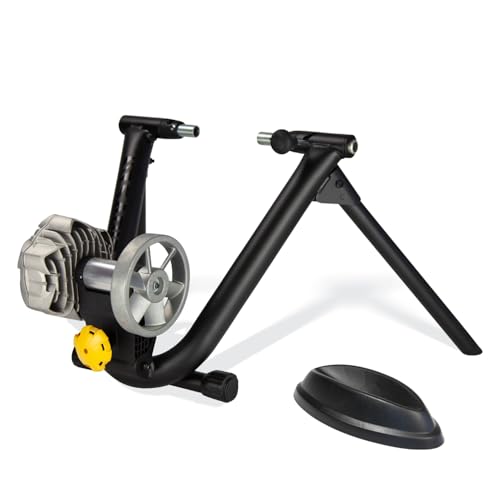
Best Simple Trainer – Saris Fluid2 Indoor Trainer
The Saris Fluid2 is a simple wheel-on trainer for cyclists who want a realistic ride without built-in wireless hardware. It can work with Zwift and Rouvy when paired with a separately purchased speed or cadence sensor, making it a lower-complexity alternative among bike trainers with ant plus setups.
Best For: Budget-conscious riders who prefer fluid resistance and do not need integrated smart connectivity.
Pros:
- Fluid resistance increases progressively as pedaling effort rises.
- Precision-balanced flywheel supports a smooth, road-like ride.
- Foldable frame makes setup and storage easier.
- Compatible with Zwift and Rouvy when paired with a sensor.
Cons:
- Speed or cadence sensor is sold separately for app compatibility.
- It does not list built-in ANT+ or Bluetooth connectivity.
The Fluid2 is best viewed as a dependable conventional trainer rather than a complete smart-training system. Its progressive resistance and foldable frame make it useful for consistent indoor riding, but riders specifically seeking integrated ANT+ connectivity should consider the Saris M2 or Elite Avanti.
How We Picked the Best Bike Trainers with Ant Plus
We selected models across several training styles and price ranges, focusing on ANT+ and Bluetooth connectivity, resistance control, app compatibility, installation, noise, and practical fit. Smart trainers were evaluated for features such as simulated gradients, maximum power, power accuracy, virtual shifting, and support for platforms including Zwift. Wheel-on trainers and sensors were included for riders who want a simpler or less expensive way to train indoors.
Because specifications and bundles can vary, confirm the included cassette, adapters, sensors, and software subscriptions before buying.
Quick Comparison
| Trainer type | Best for | Main advantage | Trade-off |
|---|---|---|---|
| Direct-drive smart trainer | Structured training and virtual riding | Accurate resistance and realistic climbs | Higher cost and more setup |
| Wheel-on smart trainer | Flexible indoor workouts | Uses your existing rear wheel | More tire noise and potentially less accuracy |
| Fluid or magnetic trainer | Simple, budget-friendly training | Easy installation and dependable resistance | Usually less interactive |
| Speed or cadence sensor | Basic app tracking | Low cost and broad bike compatibility | Does not control resistance |
Key Buying Factors for Bike Trainers with ANT+
Connectivity and App Support
ANT+ is useful for sending power, speed, cadence, and trainer data to compatible cycling computers, tablets, and computers. Bluetooth can improve device flexibility, while dual-mode connectivity is helpful if you switch between apps or screens. Check whether the trainer supports the specific app and operating system you plan to use.
Direct Drive Versus Wheel-On
Direct-drive trainers remove the rear wheel and generally offer better stability, lower tire noise, and more precise resistance control. Wheel-on models are faster to install and easier to share between bikes, but tire pressure, tread, and clamping force can affect performance.
Power, Gradient, and Accuracy
Higher maximum wattage and gradient simulation matter most for powerful riders and realistic climbing workouts. For structured training, look for published power accuracy and automatic resistance control. A sensor-only setup can track riding data but cannot reproduce the controlled resistance of a smart trainer.
Noise, Compatibility, and Maintenance
Brushless or enclosed designs may provide quieter operation, but drivetrain noise can still be noticeable. Verify axle or quick-release compatibility, cassette requirements, wheel size, and available adapters. For wheel-on trainers, use an appropriate trainer tire when recommended.
Who Should Buy Which Bike Trainers with Ant Plus?
Choose a direct-drive smart trainer if you want immersive Zwift sessions, precise interval control, realistic climbs, and a stable platform for frequent training. These are the strongest choice for serious cyclists and athletes.
Choose a wheel-on smart trainer if you want app-controlled workouts without removing the cassette or changing your bike setup. It is a practical middle ground for occasional and regular indoor riders.
Choose a fluid or magnetic trainer if affordability, simplicity, and quick setup matter more than automatic resistance. These models suit warmups, winter mileage, and riders who already manage resistance manually.
Choose a speed or cadence sensor if you already own a basic trainer or want inexpensive app tracking. It is the lightest upgrade, but it will not provide smart resistance or accurate power data by itself.