Training with reliable power data can make indoor rides more structured, measurable, and productive. This roundup compares 10 leading options, from direct-drive smart trainers to pedal, crank, and spider-based power meters.
Use the guide below to match accuracy, compatibility, connectivity, and training features to your bike, apps, and goals.
Best 10 Bike Trainers with Power Meter Picks for 2026
Best Smart Trainer Value

- 2,000W maximum power with ±2% accuracy
- Simulates gradients up to 18%
- ANT+ and BLE connectivity
Best For: Indoor riders seeking accurate power and broad app compatibility
Best Pedal-Based Option
Favero Assioma UNO Power Meter Pedal

- Left-pedal power sensor
- Bluetooth and ANT+ connectivity
- Stated ±1% angular-velocity accuracy
Best For: Road cyclists adding power measurement to an existing setup
Best High-Power Trainer

- 2,500W maximum power
- Simulates gradients up to 25%
- Stated ±1% direct-drive accuracy
Best For: Serious riders training on steep virtual climbs and hard intervals
Best for Structured Workouts

- 2,200W maximum power with ±2% accuracy
- Automatic ERG mode control
- BLE FTMS and ANT+ FE-C connectivity
Best For: Riders doing app-based intervals and structured training
Best Clipless Pedal Upgrade
Magene P715 Power Meter Pedals

- ±1% power accuracy
- 120-hour battery life
- Bluetooth and ANT+ connectivity
Best For: Road cyclists wanting portable clipless power measurement
Best Smart Trainer
Wahoo KICKR V6 Smart Indoor Trainer
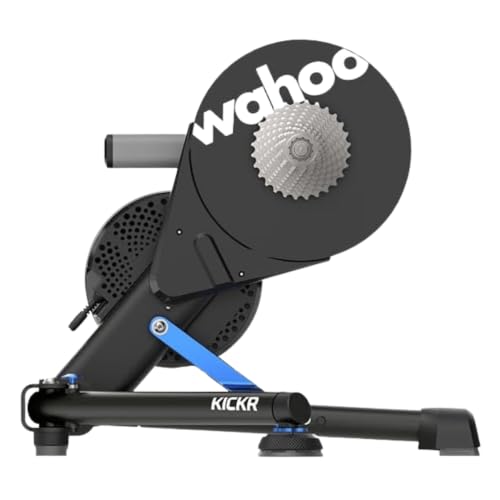
- ±1% power accuracy up to 2,200 watts
- Built-in Wi-Fi connectivity
- Automatic calibration and AXIS feet
Best For: Structured indoor training at high resistance levels
Best Dual-Sensing Pedals
Magene P715 Dual-Sensing Power Meter
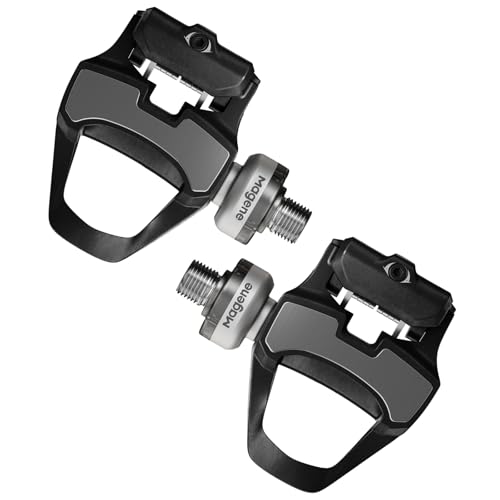
- Independent left/right power measurement
- SPD-SL compatible
- 120-hour battery life
Best For: SPD-SL riders seeking dual-sided power data
Best with Extra Features

- ±1% power accuracy
- 2200W resistance and 19% gradients
- BLE/ANT+ app connectivity
Best For: High-power virtual riding and structured indoor training
Best Crankset Upgrade

- ±1% dual-sided power accuracy
- ANT+ and Bluetooth 5.0
- Up to 300 hours of battery life
Best For: Easton-compatible crankset owners needing detailed power data
Best Lightweight Power Meter

- Dual-sided power and cadence data
- BLE/ANT+ connectivity
- 300-hour battery and IPX7 rating
Best For: Compatible road bikes used for indoor and outdoor training
Best Smart Trainer Value – ThinkRider X2Max
The ThinkRider X2Max is a practical option for cyclists comparing bike trainers with power meter capability. It delivers up to 2,000 watts, reports power within ±2%, simulates gradients up to 18%, and connects through ANT+ or Bluetooth to platforms such as Zwift.
Best For: Indoor riders who want accurate power measurement, virtual climbing, and broad software compatibility without a complicated setup.
Pros:
- Power measurement rated at ±2% accuracy with up to 2,000 watts of output.
- Simulates slopes up to 18% for more realistic software-controlled rides.
- Supports both ANT+ and BLE connectivity and uses a stable I-beam frame.
- Noise is listed at approximately 58 dB at 30 km/h.
Cons:
- Cassette is not included.
- The trainer weighs 35.2 pounds, so it is not especially portable.
- Its 18% gradient and 2,000-watt limits are lower than those of some higher-powered trainers.
The X2Max balances power accuracy, smart resistance, connectivity, and stability in one indoor trainer. Confirm your cassette requirements before ordering, but it is a well-rounded choice for structured workouts and virtual riding.
Best Pedal-Based Option – Favero Assioma UNO Power Meter Pedal
Favero Assioma Uno Power Meter Pedal | Why We Like The Favero Assioma UNO Pedal
Check Price On AmazonThe Favero Assioma UNO is a pedal-based alternative for cyclists shopping for bike trainers with power meter functionality. Its left pedal contains the power sensor, while Bluetooth and ANT+ connectivity send ride data to compatible devices.
Best For: Road cyclists who want to measure power on an existing bike rather than purchase a complete indoor smart trainer.
Pros:
- Left-pedal power sensor provides a compact power-measurement solution.
- Bluetooth and ANT+ support broad device compatibility.
- Includes cadence sensing and a gyroscope.
- Reports actual instantaneous angular velocity with stated ±1% accuracy.
Cons:
- It is a power-meter pedal, not a resistance-controlling smart trainer.
- The supplied configuration measures power through the left pedal only.
- Listed for road bikes with a 9/16-inch thread size.
The Assioma UNO makes sense when power data is the priority and you already have an indoor riding setup or want to train outdoors as well. It does not provide gradient simulation or automatic resistance control by itself.
Best High-Power Trainer – ThinkRider XXPRO
The ThinkRider XXPRO stands out among bike trainers with power meter features for its 2,500-watt maximum output and 25% gradient simulation. Its direct-drive motor provides stated ±1% data accuracy, while ANT+, Bluetooth, and Zwift compatibility support connected training.
Best For: Serious indoor cyclists who need high resistance, steep virtual climbs, and detailed smart-training features.
Pros:
- Direct-drive system offers stated ±1% data accuracy without calibration.
- Provides up to 2,500 watts and simulates gradients up to 25%.
- Can simulate downhill sections and supports virtual shifting.
- Self-power generation capability allows use without a connected power adapter.
Cons:
- The supplied notes do not specify cassette inclusion or compatibility details.
- Its high-performance feature set may be more than casual riders need.
- At approximately 242 pounds of load capacity and an iron frame, it is designed as a substantial indoor unit rather than a lightweight travel trainer.
With the highest power and gradient ratings in this lineup, the XXPRO is aimed at demanding workouts and immersive route simulation. Its direct-drive accuracy and self-powering capability add convenience for riders who train frequently.
Best for Structured Workouts – COOSPO T10
The COOSPO T10 is a belt-driven direct-drive choice for cyclists comparing bike trainers with power meter capability. It combines up to 2,200 watts, ±2% power accuracy, 15% grade simulation, ERG mode, and BLE or ANT+ FE-C connectivity for structured indoor training.
Best For: Riders who prioritize smooth operation, automatic ERG resistance, and compatibility with popular training platforms.
Pros:
- Belt-driven direct drive is designed for smooth power transfer and reduced operating noise.
- ERG mode automatically adjusts resistance to maintain a target power level.
- Supports Zwift, TrainerRoad, Rouvy, Wahoo SYSTM, MyWhoosh, and other platforms.
- Offers up to 2,200 watts, 15% grade simulation, and ±2% accuracy.
Cons:
- Cassette is not included.
- SRAM XDR 12-speed requires a separately sold XDR freehub body.
- Micro Spline is not directly compatible, and bike axle or cassette fit must be checked.
The T10 is a strong fit for interval-focused riders who want the trainer to manage resistance automatically. Its compatibility details are clearly specified, but buyers should verify their bike’s axle standard, drivetrain, and cassette before purchase.
Best Clipless Pedal Upgrade – Magene P715 Power Meter Pedals
For riders seeking bike trainers with power meter compatibility, the Magene P715 pedals provide a practical way to capture power data before it reaches a compatible cycling computer, app, or trainer setup. They offer ±1% accuracy, Bluetooth and ANT+ connectivity, and a quick installation designed for switching between bikes.
Best For: Road cyclists who want clipless power-meter pedals with long battery life and broad bike compatibility.
Pros:
- ±1% consistent power accuracy for detailed effort tracking
- Up to 120 hours of battery life
- Bluetooth and ANT+ support for compatible devices
- One-minute installation and a 318 g pair weight
Cons:
- Clipless pedal design may not suit riders using flat pedals
- Listed as a road-bike product, so compatibility should be checked for other setups
The P715 is a strong choice when you want portable power measurement rather than a dedicated indoor trainer. Its dual-protocol connectivity and easy bike-to-bike transfer make it especially useful for riders training indoors and outdoors.
Best Smart Trainer – Wahoo KICKR V6 Smart Indoor Trainer
The Wahoo KICKR V6 is a dedicated smart trainer for riders comparing bike trainers with power meter features. It delivers power measurement accurate to ±1% across resistance levels up to 2,200 watts, while Wi-Fi connectivity helps transfer ride data steadily to a computer, tablet, or smartphone.
Best For: Indoor cyclists who want a high-power smart trainer with automatic calibration and a stable Wi-Fi connection.
Pros:
- Power accuracy within ±1% with resistance up to 2,200 watts
- Wi-Fi connectivity for immediate ride-data transfer
- Automatic calibration supports consistent power readings
- AXIS feet and a high-inertia flywheel create a more outdoor-like ride feel
Cons:
- At 22 kg, it is relatively heavy to move
- Its feature set is focused on indoor training rather than portable use
Choose the KICKR V6 if you want the trainer itself to provide measured resistance and power data. Its high wattage capacity and calibration-free operation suit structured indoor training, while Wi-Fi reduces reliance on shorter-range connections.
Best Dual-Sensing Pedals – Magene P715 Dual-Sensing Power Meter
For cyclists evaluating bike trainers with power meter setups, the silver Magene P715 adds dual-sided power measurement to an SPD-SL-compatible pedal. Independent left- and right-leg readings, ±1% accuracy, and Bluetooth and ANT+ connectivity make it useful for tracking power through compatible trainers, computers, and apps.
Best For: SPD-SL users who want left/right power data without replacing their cleats.
Pros:
- Dual-sensing measurement independently records left and right leg power
- ±1% accuracy for training and racing data
- Up to 120 hours of continuous battery life
- One-minute installation with Bluetooth and ANT+ connectivity
Cons:
- SPD-SL compatibility limits it to compatible clipless systems
- Power data requires a compatible cycling computer, app, or trainer connection
The dual-sensing design gives this version an advantage for riders interested in left/right balance rather than total power alone. It is a particularly convenient upgrade for existing SPD-SL users who want to add measured power to an indoor or outdoor training routine.
Best with Extra Features – CYCPLUS R200
The CYCPLUS R200 is a direct-drive smart trainer with an integrated power meter, making it a strong option for cyclists comparing bike trainers with power meter functionality. It delivers up to 2200W, simulates gradients up to 19%, and connects to training platforms through BLE or ANT+.
Best For: Riders who want high-power indoor training, realistic gradient simulation, and app connectivity.
Pros:
- Power measurement accuracy is maintained at ±1%.
- Supports up to 2200W and 19% incline simulation.
- Works with BLE/ANT+ apps including Zwift and MyWhoosh.
- Includes adapters for quick-release and thru-axle setups.
Cons:
- Cassette is not included.
- Virtual shifting requires the separately sold CYCPLUS BC2 Shifter.
- Virtual shifting is not compatible with ERG mode.
The R200 stands out for combining accurate power data with substantial resistance, quiet operation, and uphill/downhill simulation. Confirm your cassette and bike compatibility before purchase, especially if you plan to use virtual shifting.
Best Crankset Upgrade – CooSpo S10 Power Meter
The CooSpo S10 adds power-meter capability to a compatible crankset, giving cyclists a practical way to improve data accuracy when using bike trainers with power meter setups. It records total and left/right power plus cadence, and connects to computers and apps through Bluetooth 5.0 or ANT+.
Best For: Riders with an Easton 110 BCD 4-bolt crankset who want dual-sided power and cadence tracking.
Pros:
- Provides ±1% power accuracy.
- Measures total, left/right leg power, and cadence.
- Supports simultaneous ANT+ and Bluetooth connections.
- Offers up to 300 hours of battery life and IPX7 water resistance.
Cons:
- Designed specifically for Easton 110 BCD 4-bolt crankset systems.
- Compatibility must be checked before purchase.
- It is a power-meter crankset component rather than a complete bike trainer.
The S10 is best viewed as a bike-mounted measurement upgrade for indoor and outdoor training rather than a resistance unit. Its dual-sided readings and long battery life are useful for riders who already own the required Easton-compatible crankset system.
Best Lightweight Power Meter – ThinkRider PP5 Power Meter
The ThinkRider PP5 is a spider power meter and crankset component for road bikes, offering dual-sided power and cadence data for riders pairing a compatible bike with bike trainers with power meter workflows. It uses BLE and ANT+ connectivity and supports 110 BCD, 4-bolt chainrings.
Best For: Road cyclists seeking a lightweight, dual-sided power meter for indoor and outdoor training.
Pros:
- Measures total power, left/right leg power, and cadence.
- Supports BLE and ANT+ connections with Garmin and Wahoo computers.
- Provides up to 300 hours of battery runtime.
- IPX7 waterproof construction supports use in wet conditions.
Cons:
- Supports only Easton-spec interfaces.
- Requires a 110 BCD, 4-bolt chainring pattern.
- Intended for road-bike use and is not a complete smart trainer.
The PP5 offers useful performance feedback without requiring a separate trainer-based power source, provided your drivetrain matches its interface requirements. Verify the crankset and chainring specifications carefully before ordering.
How We Picked the Best Bike Trainers with Power Meter
We selected these Bike Trainers with Power Meter options by comparing the features that matter most during structured indoor cycling: claimed power accuracy, maximum resistance, simulated gradient, connectivity, installation requirements, drivetrain compatibility, and everyday usability. The list includes complete smart trainers as well as power-meter pedals, cranksets, and spider systems because riders may want either indoor resistance control, outdoor power measurement, or both.
Specifications can vary by firmware, setup, temperature, and installation. Treat stated accuracy as a reference point, and follow each manufacturer’s calibration and maintenance instructions before comparing training data.
Quick Comparison
| Type | Best For | Main Advantage | Check Before Buying |
|---|---|---|---|
| Direct-drive smart trainer | Indoor training and virtual riding | Automatic resistance control and realistic gradients | Freehub, cassette, axle, and app compatibility |
| Power-meter pedals | Moving power data between bikes | Fast installation and easy bike swapping | Cleat system, pedal clearance, and battery charging |
| Crank or spider power meter | Permanent bike-based measurement | Clean integration and dependable outdoor use | Crank length, BCD, chainring, and frame clearance |
Key Buying Factors for Bike Trainers with Power Meter
Decide Whether You Need Resistance Control
A smart trainer controls resistance in apps such as Zwift, TrainerRoad, and similar platforms. A pedal, crank, or spider power meter measures output but does not create resistance, so it must be paired with a separate trainer for automated gradients and workouts.
Check Accuracy and Data Transmission
Look for a clearly stated accuracy figure, cadence support, and both ANT+ and Bluetooth if you use multiple devices. Dual-sided pedals can show left-right contribution, while single-sided systems may be simpler and less expensive but estimate total power from one leg.
Confirm Mechanical Compatibility
For direct-drive units, verify cassette type, freehub standard, axle spacing, and whether a cassette is included. For pedals and crank-based meters, confirm cleat compatibility, crank length, bottom-bracket or crank standard, chainring BCD, and available frame clearance.
Consider Noise, Power, and Setup
High maximum wattage and gradient simulation are useful for sprints, steep virtual climbs, and powerful riders, but quiet operation and stable connectivity often matter more for daily use. A direct-drive trainer usually offers better stability, while pedals and crank systems are easier to transfer between bikes.
Who Should Buy Which Bike Trainers with Power Meter?
Choose a direct-drive smart trainer if your priority is immersive indoor training with automatic resistance, virtual shifting, and simulated climbs. These are the most complete option for structured workouts and virtual cycling.
Choose power-meter pedals if you ride outdoors regularly, own multiple bikes, or want the simplest installation. They are especially practical for riders who need portable power data.
Choose a crankset or spider power meter if you want a more permanent, low-profile setup on one primary bike. Check fit carefully before ordering, particularly the crank length, BCD, chainring format, and drivetrain configuration.