A good slant board for stretching can make calf, ankle, and Achilles work more comfortable, more consistent, and easier to progress over time.
Below, we focus on practical choices for home use, mobility training, and rehab-minded buyers who want the right angle, grip, and build quality.
Best 10 Slant Board for Stretching Picks for 2026
PT-Recommended Wooden Option
StrongTek Adjustable Slant Board

- 5 incline settings for stretching and squats
- Wood construction with anti-slip treads
- Side handles make it easier to move
Best For: sturdy stretching, rehab, and lower-body mobility
Heavy-Duty Stability Pick
Professional Wooden Slant Board
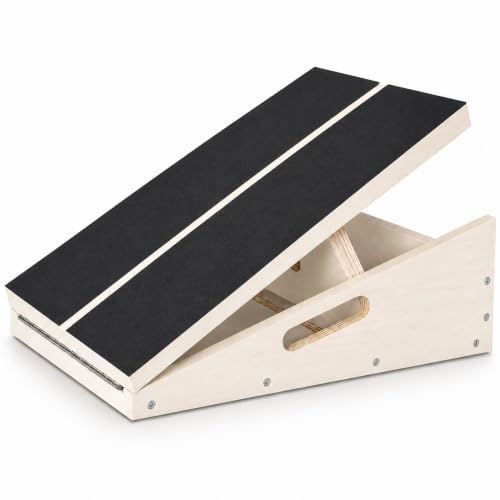
- Reinforced hardwood build supports up to 500 lbs
- Five angles for calf and Achilles stretching
- Non-slip top and bottom surfaces
Best For: users wanting maximum stability and higher capacity
Portable Travel Choice
StrongTek ABS Plastic Slant Board

- Lightweight ABS design is easy to carry
- Non-slip surface with secure heel support
- Five angles for stretching and mobility work
Best For: travel, office use, and compact storage
Compact Hardwood Pick

- 5 lb board with built-in handle
- Four incline angles for mobility work
- Wood build with 500 lb capacity
Best For: compact storage, carry convenience, and basic stretching
Upgraded Recovery Pick
Adjustable Wooden Calf Stretch Board with Bands

- 5 incline settings for stretching progression
- Includes two resistance bands and a guide
- Wood build supports up to 300 lb
Best For: Home users focused on mobility, recovery, and guided calf stretches
3-in-1 Balance Choice
Wooden Slant, Stretch, and Balance Board

- 3-in-1 design for stretching, balance, and squats
- 7 incline angles from 18° to 40°
- Pine wood build supports up to 300 lb
Best For: Users who want one board for mobility work, balance training, and squats
Compact Foam Budget Pick
Adjustable Squat Wedge for Stretching

- Lightweight foam wedge at just 10.56 oz
- 5 angles for stretching and mobility work
- Non-slip design for stable barefoot use
Best For: Shoppers wanting a compact, lightweight wedge for basic calf and ankle stretches
Portable 5-Angle Wooden Choice
5-Angle Portable Adjustable Calf Wooden Stretch Board

- 5 adjustable angles from 23° to 45°
- Folds for easy transport and needs no setup
- 300 lb capacity with poster and instructions
Best For: Users who want a portable calf stretcher for home, gym, or travel
Gen 3 Stability Pick
Adjustable Incline Board for Squats & Stretching

- Four angles: 20°, 25°, 30°, and 40°
- Solid wood with non-slip surface and 300 lb support
- Works as a calf stretcher, squat wedge, and balance tool
Best For: Buyers who want a stable incline board for stretching and mobility
Grip-Focused Rehab Option
Portable Wooden Incline Board with Training Poster

- Five adjustable angles for varied difficulty
- PVC sandpaper top and EVA base improve grip
- Foldable design includes poster and instruction guide
Best For: People who want a traction-focused board for rehab and mobility
PT-Recommended Wooden Option – StrongTek Adjustable Slant Board
If you want a slant board for stretching that feels stable and built for regular use, this StrongTek wooden model is a strong fit. It offers five incline positions, a non-slip surface, and side handles, making it practical for calf stretches, ankle mobility work, squats, and general warm-up or recovery routines.
Best For: Users who want a sturdy wooden slant board for stretching, rehab, and squat work.
Pros:
- Adjustable to 5 positions: 15, 20, 25, 30, and 35 degrees.
- Wooden build with anti-slip safety treads for added stability.
- Recommended for pre/post-workout stretching and recovery support.
- Side carry handle helps with portability.
Cons:
- At 9 pounds, it is less portable than lighter plastic options.
- Fixed-size design may be bulkier for small storage spaces.
This is a good all-around choice if you value a durable wooden construction and want a board that can handle stretching, mobility, and rehab-focused use.
Heavy-Duty Stability Pick – Professional Wooden Slant Board
This slant board for stretching is aimed at users who want a more robust, professional-feeling platform. With five adjustable angles, a reinforced hardwood build, and a top-and-bottom non-slip surface, it is designed for calf stretching, Achilles and plantar fasciitis relief, and heel-elevated squat work.
Best For: Buyers who want a high-stability wooden calf stretcher with a higher weight capacity.
Pros:
- Supports up to 500 lbs with reinforced hardwood construction.
- Five angle settings from 15° to 35° for gradual progression.
- Non-slip surface on both top and bottom for better safety.
- Includes a visual exercise guide and a built-in carry handle.
Cons:
- Heavier than compact plastic alternatives.
- Best suited for users who want a more rigid, structured board.
If stability is your top priority, this board stands out with its reinforced design and strong weight capacity while still covering the core stretching and rehab needs.
Portable Travel Choice – StrongTek ABS Plastic Slant Board
If portability matters most, this ABS plastic slant board for stretching keeps the setup simple and light. It offers five angle options, a textured non-slip surface, and secure heel support, making it useful for calf stretching, ankle mobility, physical therapy routines, and travel-friendly home gym use.
Best For: People who want a lightweight, easy-to-carry stretching board for home, office, or travel.
Pros:
- Lightweight 3.7 lb design makes it easy to carry and store.
- ABS construction is built for regular use and supports up to 300 lbs.
- Textured surface and heel lip help keep feet secure.
- Compact size works well for travel, office, or small spaces.
Cons:
- Plastic build may feel less substantial than hardwood boards.
- Angle range and size may be less suited to users wanting a larger platform.
This model is a practical pick if you want a durable but portable board that is easy to move between rooms, the gym, or the road.
Compact Hardwood Pick – TEMI Wooden Incline Stretcher
This slant board for stretching is a compact wooden option designed for portability and everyday mobility work. It weighs just 5 lbs, includes a built-in handle, and offers four wedge angles, making it a useful fit for calf stretching, heel work, squat positioning, and ankle rehab.
Best For: Users who want a compact hardwood slant board with simple angle options and easy transport.
Pros:
- Lightweight 5 lb design with a built-in handle for carrying.
- High-density wooden build with a 500 lbs weight capacity.
- Four angles: 20°, 25°, 30°, and 40°.
- Soft non-slip surface and sturdy base help support stable use.
Cons:
- Fewer angle choices than some five-position boards.
- Single-block style may be less versatile than larger multi-panel designs.
This is a straightforward choice for anyone who wants a durable wooden wedge that is easy to move and still covers the basics of stretching and mobility training.
Upgraded Recovery Pick – Adjustable Wooden Calf Stretch Board with Bands
If you want a slant board for stretching that also supports rehab work, this wooden model adds useful extras without getting complicated. It offers 5 incline angles, a non-slip build, and included resistance bands, making it a practical pick for calf stretches, ankle mobility, and basic home physical therapy.
Best For: Buyers who want an adjustable wooden slant board with bands for stretching, mobility, and recovery work.
Pros:
- 5 adjustable angles from 23° to 45° for gradual progression
- 11-layer poplar wood construction with 300 lb weight support
- Non-slip EVA base and PVC sandpaper surface help reduce slipping
- Includes two latex-free TPE resistance bands plus a training guide
Cons:
- Wooden design may be less cushioned than foam options
- At 4.5 lb, it is portable but not ultralight
- Angle changes are functional, but not as many as some 7-angle boards
This is a solid all-around choice if you want a slant board for stretching with extra training value built in. The included guide and bands make it especially useful for structured calf mobility and recovery routines at home, in the gym, or at the office.
3-in-1 Balance Choice – Wooden Slant, Stretch, and Balance Board
This slant board for stretching stands out if you want one tool that can do more than calf work. Its 3-in-1 design combines a stretch platform, a slant board, and a balance board, with 7 incline angles to match different exercise levels.
Best For: People who want a multi-use wooden board for stretching, balance training, and squats.
Pros:
- 3-in-1 design works as a slant board, stretch platform, and balance board
- 7 adjustable angles from 18° to 40°
- Anti-slip surface adds stability during barefoot use
- Durable pine wood construction with 300 lb weight capacity
Cons:
- More complex than a basic single-purpose wedge
- Requires a curved base setup for balance mode
- Heavier than some compact foam alternatives at 3.07 kg
If you want versatility, this is the most feature-packed option in the group. It makes sense for users who will use it for stretching, balance drills, and squat support rather than only for quick calf mobility sessions.
Compact Foam Budget Pick – Adjustable Squat Wedge for Stretching
If you want a simple slant board for stretching with a compact footprint, this foam wedge is a straightforward option. It offers 5 adjustable angles, a non-slip surface, and a lightweight design that fits well into a basic mobility or physical therapy routine.
Best For: Buyers who want a small, easy-to-use foam wedge for calf stretches and ankle mobility.
Pros:
- 5 adjustable angles for flexible stretching positions
- Very lightweight at 10.56 oz for easy handling and storage
- Non-slip yoga foam construction for stable use
- Designed for calf stretching, ankle mobility, squats, and PT work
Cons:
- Foam construction may feel less rigid than wood boards
- No extra accessories included in the notes
- Compact size may feel limiting for some users
This is the most minimalist pick of the three, which can be a plus if you value convenience over bells and whistles. It is a practical choice for basic stretching and mobility work, especially when you want something easy to move, store, and use often.
Portable 5-Angle Wooden Choice – 5-Angle Portable Adjustable Calf Wooden Stretch Board
If you want a slant board for stretching that is simple to use and easy to move, this wooden option keeps things straightforward. It arrives ready to use, folds for transport, and offers five incline settings so you can choose a gentler or more challenging calf stretch as your mobility improves.
Best For: Beginners and experienced users who want a portable, no-setup calf stretcher for home, gym, or travel.
Pros:
- Five adjustable angles: 23°, 30°, 35°, 40°, and 45°
- Foldable, portable design with no setup required
- 300 lb weight capacity and wooden build
- Includes a training poster and instructions
Cons:
- Heavier than some compact stretching accessories at 4.6 lb
- Designed mainly for calf and lower-leg stretching rather than broad training variety
This is a practical pick if you want a straightforward slant board for stretching with multiple incline levels and easy portability. The included poster may also help users get started without guessing at positions.
Gen 3 Stability Pick – Adjustable Incline Board for Squats & Stretching
This slant board for stretching is built for users who want a sturdier, more performance-focused incline board. With four preset angles, a solid wood construction, and a non-slip surface, it is positioned for calf stretching, squat work, balance training, and daily mobility routines.
Best For: People who want a stable wooden incline board for stretching, squat wedges, and mobility work.
Pros:
- Four optimized angles: 20°, 25°, 30°, and 40°
- Solid wood build with a non-slip surface
- Supports up to 300 lb for stretching and balance work
- Ready to use, compact, and portable
Cons:
- Only four angle settings, so progression steps are less granular
- Heavier than ultra-light foam-style stretching tools
If you care most about stability and versatility, this board makes a strong case. It can serve as a calf stretcher, squat wedge, or balance tool, which makes it useful beyond basic flexibility drills.
Grip-Focused Rehab Option – Portable Wooden Incline Board with Training Poster
For shoppers comparing a slant board for stretching, this model stands out for its grip-focused design. The foldable wooden board uses a PVC sandpaper top and EVA base for traction, and it includes five adjustable angles plus a training poster to support stretching, rehab, and squat use.
Best For: Users who want a portable, traction-focused slant board for stretching, rehab, and lower-body mobility work.
Pros:
- Foldable and easy to carry to home, office, gym, or clinic
- Five adjustable angles for different difficulty levels
- PVC sandpaper top and EVA base for better grip
- Includes a training poster and instruction guide
Cons:
- At 4 lb, it is not the lightest option available
- Comfort details are less emphasized than traction and stability
This is a well-rounded choice if safety and grip matter more than a minimalist design. The included guide is especially useful if you want help using the board correctly and avoiding mistakes.
How We Picked the Best Slant Board for Stretching
We looked for stable construction, useful angle adjustability, strong traction, and a size that works for real daily use. A solid Slant Board for Stretching should support controlled calf and ankle mobility without wobble, slipping, or awkward foot placement.
We also favored models with clear weight limits, portable designs, and surfaces that are easy to clean and comfortable under bare feet or shoes.
Quick Comparison: What Matters Most
Some boards are built for portability and quick setup, while others emphasize wider platforms, higher capacity, or more dialed-in incline settings. If you want simple calf stretching at home, a basic adjustable wooden model is often enough. If you plan to use the board for squats, balance work, or heavier training, look for a higher-capacity design with extra stability.
Key Buying Factors for a Slant Board for Stretching
Incline Range and Adjustability
More angle options give you better progression. Lower angles are usually friendlier for beginners or tight calves, while steeper settings can challenge ankle dorsiflexion and deeper mobility work.
Surface Grip and Foot Security
Non-slip tops, heel stops, and textured surfaces help keep your feet planted. That matters most when you are loading the board for prolonged holds or using it before lifts.
Material and Stability
Wood boards often feel sturdy and familiar, while ABS plastic or foam-based designs may be lighter or easier to move around. The best choice depends on whether you prioritize portability or a more solid underfoot feel.
Weight Capacity and Board Size
Check the listed capacity if you plan to use the board for strength training, not just stretching. Larger platforms can also feel more comfortable for bigger shoe sizes and more balanced stance work.
Extra Features
Training posters, side handles, and resistance bands are helpful add-ons, but they should not matter more than basic safety and stability. Choose extras only if they match how you will actually train.
Who Should Buy Which Slant Board for Stretching?
Beginners and everyday home users should start with a simple adjustable board that has strong grip and moderate angle options. Travelers or minimalist buyers may prefer a lighter portable model that stores easily. If you are using a Slant Board for Stretching as part of rehab, mobility training, or squat prep, prioritize wide footing, stable construction, and a gradual angle progression.
In short, the right board is the one you will use consistently. Pick the model that fits your space, your training style, and your comfort level, and you will get far more value from it over time.