Finding the best walking pad for seniors means looking beyond speed and portability. Stable handrails, simple controls, emergency-stop features, and a comfortable walking surface can make everyday exercise feel safer and more manageable.
These 10 options cover compact under-desk models and more supportive treadmills with extended handles, incline settings, and senior-focused safety features. Use the guide below to match the machine to the user’s mobility, space, and exercise goals.
Best 10 Walking Pad for Seniors Picks for 2026
Best Safety-Focused Pick
Redliro Senior Walking Treadmill

- Extended handrails support balance
- Three gentle manual incline levels
- Folding design with transport wheels
Best For: Seniors needing extra support and simple home storage
Best Compact Budget Option

- Compact, wheeled design for small spaces
- Five-layer non-slip cushioned belt
- Remote control and clear LED display
Best For: Light walking in apartments, offices, or other tight spaces
Best Emergency-Stop Design

- Full-length handrails surround the walking area
- Emergency stop button and safety key
- Six-layer cushioning with quiet motor
Best For: Seniors and rehabilitation users prioritizing safety
Best Incline Training Pick
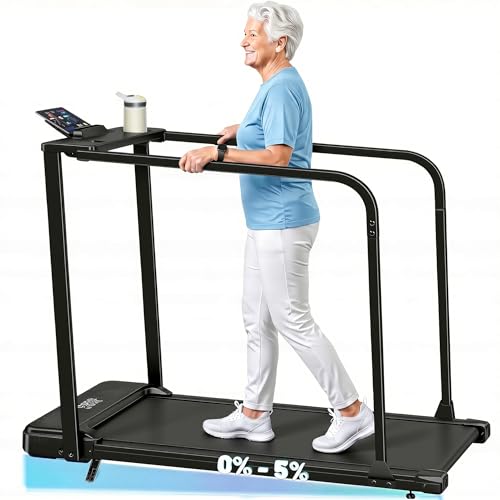
- Extra-long handrail for supported walking
- Manual 5% incline for added challenge
- Quiet motor and six-layer cushioning
Best For: Seniors seeking gentle incline-based home exercise
Best Stability Pick
Redliro Senior Walking Treadmill

- Full-length handrails and emergency safety key
- 0-2% manual incline with 0.5 mph starting speed
- Folds, rolls easily, and supports up to 300 pounds
Best For: Seniors and recovery users seeking maximum hand support
Best High-Incline Option
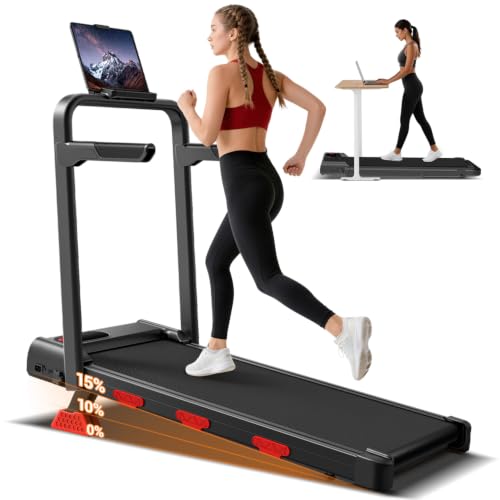
- Flat, 10%, and 15% manual incline positions
- Quiet brushless motor with 350-pound capacity
- Low-profile body stores under furniture or upright
Best For: Experienced walkers wanting compact hill-training versatility
Best Rehab-Focused Pick

- Starts at 0.3 mph with extended handrails and safety key
- Includes resistance bands and two-level manual incline
- Heart-rate sensors, cushioned belt, and foldable 40-pound frame
Best For: Recovery-focused users wanting gentle pacing and rehab extras
Most Versatile Pick

- Removable handlebar supports multiple configurations
- 0.6–7.6 MPH range with mild incline
- 350-pound capacity and cushioning
Best For: Homes needing a versatile handlebar treadmill
Best Stability Features
- Extra-long handrail for balance support
- Gentle 5% incline and 0.6–4.0 MPH range
- LED display, remote, and joint-focused belt
Best For: Seniors and beginners seeking controlled walking
Best Compact Budget-Style Option

- Slim 10.5 cm profile with transport wheels
- Simple controls and included remote
- Five-layer cushioning for light walking
Best For: Confident walkers needing easy storage
Best Safety-Focused Pick – Redliro Senior Walking Treadmill
For shoppers seeking a walking pad for seniors with extra stability, the Redliro combines extended handrails, a low maximum speed, and a compact folding design. Its gentle incline settings and senior-oriented controls make it practical for daily walking at home.
Best For: Seniors or recovery users who prioritize handrail support, simple controls, and easy storage.
Pros:
- Extended support rails help improve balance and confidence.
- Three manual incline levels—0%, 1%, and 2%—allow gentle progression.
- Folds manually and includes transport wheels for compact storage.
- Offers 12 programs, goal tracking, quick pause, and a mute button.
Cons:
- The 14.8-inch belt is narrower than some full-size treadmill belts.
- The maximum speed is limited to 5 mph, making it more suited to walking than fast running.
With a 300-pound capacity and a 39.3-inch walking surface, this is a well-rounded choice for supported home walking. The long rails and low-speed range are its strongest advantages for senior users.
Best Compact Budget Option – Yagud Incline Walking Pad
This walking pad for seniors is a compact, straightforward option for light home exercise. It provides a remote control, clear LED workout metrics, and a cushioned non-slip belt while remaining easy to move and store.
Best For: Users who want a lightweight walking pad for small spaces and uncomplicated low-speed workouts.
Pros:
- Compact profile and transport wheels make it easy to place under furniture or in a corner.
- Five-layer non-slip belt and silicone shock absorbers cushion walking.
- Remote control allows speed and start/stop adjustments without interrupting exercise.
- LED display shows speed, distance, time, and calories.
Cons:
- The stated 220-pound capacity in the product description conflicts with the listed 200 kg specification, so buyers should verify the rating.
- It reaches only 3.8 mph and offers limited program functionality.
- The supplied notes do not mention extended handrails, which may matter for users needing substantial balance support.
This model emphasizes portability and basic walking rather than advanced senior-safety features. Confirm the weight rating before purchase, especially if stability and capacity are primary concerns.
Best Emergency-Stop Design – YESOUL Senior Treadmill
For a walking pad for seniors centered on controlled, supported movement, the YESOUL includes full-length handrails, an emergency stop button, and a safety key. Its shock-absorbing belt and quiet motor are suited to gentle daily walking at home.
Best For: Seniors and rehabilitation users who want extensive handrail coverage and emergency-stop protection.
Pros:
- Long handrails wrap around both sides and the front for added support.
- Emergency stop button and safety key provide quick shutdown protection.
- Six-layer cushioning helps reduce impact on knees, hips, and ankles.
- Quiet 2.5HP brushless motor operates from 0.6 to 3.8 mph.
Cons:
- The unit is non-foldable, which may limit storage flexibility.
- The 37.2-inch belt length is relatively compact for users with a longer stride.
- App connectivity may be unnecessary for shoppers seeking the simplest possible setup.
The YESOUL stands out for safety equipment and surrounding handrail coverage rather than speed or storage convenience. Its 300-pound capacity, cushioning, and slow starting speed make it a strong option for cautious home walking.
Best Incline Training Pick – ANCHEER Senior Walking Pad
The ANCHEER is a walking pad for seniors designed to add gentle uphill training without requiring a faster pace. Its extra-long handrail, 5% incline, shock-absorbing belt, and remote control support steady, customized walking in small home spaces.
Best For: Seniors who want supported walking with a manually adjustable incline for gradual leg and cardiovascular training.
Pros:
- Extra-long handrail provides a stable grip for seniors and beginners.
- Manual 5% incline can increase workout challenge while maintaining a gentle pace.
- Six-layer belt cushioning is designed to reduce impact during walking.
- Quiet brushless motor, LED display, remote, phone holder, and cup tray add convenience.
Cons:
- The incline is less adjustable than models offering several incline levels.
- The product is described as compact, but the supplied notes do not clearly confirm a folding mechanism.
- The maximum speed is 4 mph, so it is primarily intended for walking and light jogging.
Choose this model if incline walking is a priority and the user is comfortable with a fixed 5% setting. The long handrail and 300-pound capacity add reassurance, while the under-40 dB motor supports quieter home use.
Best Stability Pick – Redliro Senior Walking Treadmill
If stability is your main concern, this walking pad for seniors is designed around support and simple operation. Full-length handrails, a low 0.5 mph starting speed, and a true 0% incline make it suitable for gentle indoor walking, recovery routines, and gradual progression.
Best For: Seniors and recovery users who prioritize continuous hand support, straightforward controls, and easy room-to-room mobility.
Pros:
- Full-length handrails provide support across the walking deck, while the safety key can stop the treadmill in an emergency.
- Offers a joint-friendly 0-2% manual incline range, including a natural-feeling flat setting.
- Large display numbers, rail controls, and a screen-off button help reduce the need to bend or release the handrails.
- Folds for storage and has external wheels for moving it between rooms; capacity is up to 300 pounds.
Cons:
- The incline is manual rather than electronically adjusted.
- Its 5 mph top speed is aimed more at walking and light jogging than faster running.
For shoppers comparing a walking pad for seniors, the Redliro stands out when dependable hand support and low-impact pacing matter more than a minimalist under-desk design. The 12-month warranty and stated 24-hour support response add reassurance for home use.
Best High-Incline Option – LONTEK Incline Walking Pad
The LONTEK is a walking pad for seniors who want more than flat walking and can safely manage steeper manual grades. It provides flat, 10%, and 15% incline positions, along with a quiet brushless motor, a low-profile frame, and a 0.6-6.2 mph speed range.
Best For: Experienced walkers who want adjustable hill-style training, a compact design, and a higher 350-pound weight capacity.
Pros:
- Three manually changed walking levels—flat, 10%, and 15%—allow varied incline workouts without complicated electronic settings.
- Quiet 3.0 HP brushless motor operates below 45 dB and supports users up to 350 pounds.
- Low-profile construction can slide under beds, sofas, or desks and can be stored upright.
- Cushioned belt with side impact strips, a removable device holder, and an LED progress display add everyday convenience.
Cons:
- The 10% and 15% grades may be too demanding for users needing gentle rehabilitation walking.
- The supplied notes do not indicate full-length handrails or an emergency safety key.
- Incline changes require manual repositioning rather than button controls.
This model is less focused on senior-specific stabilization than the other options, but it is compelling for users who want a portable walking pad with meaningful hill settings. Start on the flat position and use the steeper grades only if they match your fitness and balance abilities.
Best Rehab-Focused Pick – BESTGYM Senior Treadmill
This walking pad for seniors combines extended detachable handrails with rehabilitation-oriented extras. Its 0.3 mph starting speed, emergency stop system, heart-rate sensors, resistance bands, and two-level manual incline are suited to users building a gradual indoor walking routine.
Best For: Seniors and recovery users who want very slow starting speeds, added hand-training accessories, and a compact treadmill with support rails.
Pros:
- Long armrests and a magnetic safety key provide added support and automatic shutoff protection.
- The 0.3-6.2 mph speed range accommodates gentle walking through jogging, with heart-rate sensors in the armrests.
- Includes 10 resistance bands for hand rehabilitation training and a two-level manual incline.
- Six-layer, 40-by-16-inch belt is designed for traction and joint comfort; the unit weighs 40 pounds and folds.
Cons:
- The 265-pound capacity is lower than the capacities of the other listed models.
- The incline range is limited to a maximum of 2% and is manually adjusted.
- The shaking function and multiple accessories may be unnecessary for shoppers seeking a basic walking treadmill.
Among these options, BESTGYM offers the most rehabilitation-specific feature mix, particularly for users who value resistance-band work and a very low starting speed. Its lower weight capacity should be checked carefully before purchase, and users with balance concerns should still follow appropriate supervision guidance.
Most Versatile Pick – KASSADIN V800 Walking Pad
For shoppers comparing a walking pad for seniors, the KASSADIN V800 stands out for its supportive handlebar setup, mild incline, and broad speed range. Its 0.6–7.6 MPH operation, layered cushioning, and low-noise motor make it suitable for gentle walking as well as more active home workouts.
Best For: Households wanting a handlebar treadmill that can also convert for under-desk use.
Pros:
- Removable bars allow use with or without a handlebar.
- Supports up to 350 pounds and offers a 3.0HP motor.
- Quiet operation is rated below 45dB.
- Layered cushioning and a built-in incline add versatility.
Cons:
- Its 7.6 MPH top speed and added features may be more than needed for simple senior walking.
- The notes do not specify the exact incline percentage.
The V800 is a flexible choice when stability, capacity, and multi-use design matter more than a minimal footprint. Seniors should use the handlebar and select a comfortable speed before progressing.
Best Stability Features – Senior Recovery Walking Pad
This model is purpose-built for shoppers seeking a walking pad for seniors with extra support. Its long ergonomic handrail, gentle 5% incline, 0.6–4.0 MPH range, and quiet brushless motor emphasize controlled, low-impact movement at home.
Best For: Seniors and beginners prioritizing balance support and gentle rehabilitation-style walking.
Pros:
- Extra-long handrail provides a steady grip.
- 5% incline can add intensity without requiring higher speed.
- Six-layer belt is designed to reduce impact on joints.
- Clear LED display, remote control, cup holder, and phone/tablet bracket improve convenience.
Cons:
- The maximum speed is limited to 4.0 MPH, so it is not intended for faster running.
- Remote-control batteries are not included.
- The warranty is listed as one year.
Among these options, this is the most directly focused on senior-friendly stability and recovery walking. Its slower speed ceiling and long handrail make it easier to keep workouts measured and controlled.
Best Compact Budget-Style Option – Slim Under-Desk Walking Pad
For buyers who need a walking pad for seniors that stores easily, this slim electric model offers simple controls and a compact profile. It runs from 0.6–4.0 MPH, includes a remote, and uses a five-layer belt with honeycomb cushioning for lower-impact home or office walking.
Best For: Users who value easy storage, straightforward operation, and under-desk walking.
Pros:
- One-button startup and remote speed adjustment simplify operation.
- 10.5 cm profile and transport wheels help with storage.
- Five-layer belt and honeycomb cushioning are designed to reduce joint pressure.
- 45dB motor noise is suitable for shared home or office spaces.
Cons:
- It has no supplied handrail, which may matter for seniors who need balance support.
- The maximum speed is 4.0 MPH.
- The supplied details contain an inconsistent maximum-weight listing, so buyers should verify capacity before ordering.
This is the most space-conscious choice, but it is better suited to confident walkers who do not require a support rail. Its simple controls and low profile are useful for light daily activity.
How We Picked the Best Walking Pad for Seniors
We focused on features that matter most for safe, consistent home walking: secure handrails, accessible controls, emergency-stop systems, speed ranges suitable for walking, weight capacity, deck stability, and storage-friendly designs. Models with incline settings can add variety, but stability and ease of use should come first for older adults or anyone returning to exercise.
We also considered whether each treadmill suits a particular home environment, including small rooms, offices, recovery areas, and spaces where the machine must be moved after use. Product specifications can vary by configuration, so confirm the current dimensions, capacity, and included accessories before buying.
Quick Comparison
| Feature | Best for | What to look for |
|---|---|---|
| Long or extended handrails | Extra balance support | Rigid construction and a comfortable grip height |
| Incline adjustment | More varied walking workouts | Low starting incline and straightforward controls |
| Compact, slim design | Small homes or under-desk use | Easy transport and adequate deck length |
| Emergency-stop function | Safety-conscious users | Clearly accessible stop button, clip, or remote |
| Higher weight capacity | Larger users or added stability | Capacity comfortably above the user’s weight |
Key Buying Factors for a Walking Pad for Seniors
Stability and Handrail Design
A walking pad should not shift, wobble, or force the user to lean forward. Full-length or extended handrails generally provide more support than a short front bar. Check the treadmill’s footprint, frame construction, and whether the rails are positioned at a natural height.
Speed and Controls
Choose a model with a low minimum speed and gradual adjustments. Large, readable controls or a simple remote can be easier to use than a feature-heavy console. Make sure the user can stop the belt quickly without searching for a button.
Deck Size, Cushioning, and Clearance
A longer and wider belt gives users more room to recover from a misstep. Cushioning may reduce impact on knees and hips, while a low step-up height can make mounting easier. Place the machine on a level surface with clear space around it.
Incline, Capacity, and Maintenance
Incline is useful for progression, but it is not essential for every senior. Confirm the maximum user weight, available ceiling clearance, belt lubrication requirements, and warranty support. Keep the walking surface clean and inspect handrails and cables regularly.
Who Should Buy Which Walking Pad for Seniors?
Choose a long-handrail model for users who value balance support or are rebuilding confidence after a period of inactivity. An incline model fits walkers who want more challenge without increasing speed, provided they can use the incline safely. Compact slim designs work best in apartments, offices, or rooms where storage space is limited.
For recovery walking or users with reduced stability, prioritize extended rails, an emergency-stop feature, a low speed range, and a stable deck over maximum speed. More independent walkers may prefer a portable under-desk-style pad, but should still choose a model with a suitable belt length and enough clearance for a natural stride. When in doubt, ask a healthcare professional whether treadmill walking is appropriate and supervise initial use.