The best bike computers with Komoot make turn-by-turn navigation easier while keeping speed, distance, elevation, and ride data visible at a glance. The right model can reduce phone dependence and help you follow planned routes with greater confidence.
This roundup compares 10 options across navigation features, display quality, connectivity, durability, battery life, and value so you can choose a computer that matches your riding style.
Best 10 Bike Computers with Komoot Picks for 2026
Best Touchscreen Navigation

- 3.3-inch touchscreen plus buttons
- Komoot route import and voice navigation
- Automatic off-course rerouting
Best For: Riders wanting a large, voice-guided navigation display
Best Connected Navigation

- Automatic Komoot route downloads
- Turn-by-turn prompts with LED and audio cues
- 20-hour battery and radar integration
Best For: Connected riders who prioritize simple route syncing
Best Offline Maps
- Worldwide offline map downloads
- Touchscreen, buttons, and off-course alerts
- 130-plus metrics with e-bike support
Best For: Explorers and e-bike riders needing offline route guidance
Best Long-Battery Value

- Up to 80 hours of battery life
- Komoot-compatible app data sharing
- ANT+ sensor support and IP67 protection
Best For: Endurance riders wanting simple tracking with minimal charging
Best Premium Navigation

- 2.8-inch color touchscreen with detailed map views
- Offline routes and connected-app rerouting
- Wi-Fi sync plus indoor training support
Best For: Explorers who want feature-rich navigation and training tools
Best Long-Battery Bundle

- More than 60 hours of working time
- Includes speed and cadence sensor
- Syncs ride data to Strava
Best For: Riders seeking long runtime and a ready-to-use sensor bundle
Best Connected Touchscreen
COOSPO CS600 GPS Bike Computer

- 2.4-inch color touchscreen with auto-backlight
- Breadcrumb route navigation and wireless syncing
- Supports radar, lights, shifters, and trainers
Best For: Cyclists building a connected, customizable riding setup
Long-Range Data Companion

- 40-hour battery supports extended rides
- Shares ride data to Komoot and Strava
- Bluetooth and ANT+ sensor support
Best For: Long-distance riders who want essential metrics and app-based Komoot sharing
Color Route Navigator

- Color navigation includes turn reminders
- Supports GPX routes and automatic re-routing
- Wi-Fi, ANT+, and Bluetooth connectivity
Best For: Navigation-focused riders who want colorful route guidance and flexible route imports
Komoot Route Specialist

- Imports routes directly from Komoot
- Offers turn and direction reminders
- Tracks more than 100 riding data points
Best For: Cyclists who want Komoot route navigation with detailed ride metrics
Best Touchscreen Navigation – iGPSPORT BSC500
The iGPSPORT BSC500 is a strong option for riders seeking bike computers with Komoot support, especially if you prefer a large touchscreen and spoken navigation cues. It can import routes from Komoot and other services, while dual-band, five-satellite positioning is designed to improve route accuracy.
Best For: Riders who want a large display, touchscreen controls, voice prompts, and automatic rerouting.
Pros:
- 3.3-inch touchscreen with button operation and space for up to 12 data fields per page
- Imports routes from Komoot, Strava, and route files through the iGPSPORT app
- Voice navigation, speed-based turn warnings, and automatic off-course route planning
- IPX7 rating, ANT+/Bluetooth connectivity, and a two-year warranty
Cons:
- At 107 g, it is heavier than some compact cycling computers
- Touchscreen operation may be less convenient in wet or gloved conditions
The BSC500 stands out for navigation-focused riders who value visibility and audible guidance. Its climbing tools and training analysis also make it more versatile than a basic route-display computer.
Best Connected Navigation – Wahoo ELEMNT BOLT V3
The Wahoo ELEMNT BOLT V3 is a compact choice among bike computers with Komoot integration. It automatically downloads saved Komoot routes, provides on-device turn-by-turn prompts, and can generate routes to destinations through the computer or companion app.
Best For: Road and trail riders who want streamlined route syncing, clear turn prompts, and broad connected features.
Pros:
- Automatically downloads routes from compatible Komoot and other accounts
- Supports GPX and TCX files with on-device turn-by-turn navigation
- Top LEDs and audible cues provide quick turn and off-course alerts
- 20-hour battery life, IPX7 protection, and ANT+ radar integration
Cons:
- Its 2.3-inch LCD is smaller than the displays on several touchscreen models
- Smart notifications and LiveTrack require a smartphone connection
- Uses button controls rather than a touchscreen
The BOLT V3 is a practical pick for riders already using connected cycling services. Its automatic syncing and radar support reduce setup friction, while the compact format keeps handlebar clutter down.
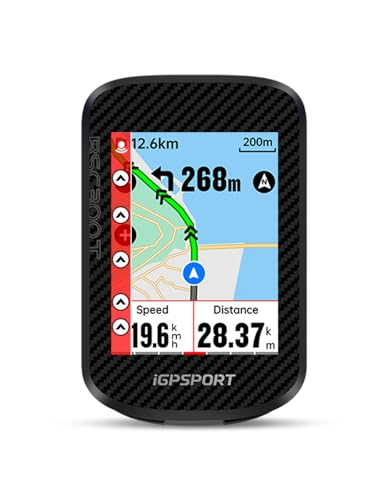
Best Offline Maps – iGPSPORT BSC300T
The iGPSPORT BSC300T is designed for riders comparing bike computers with Komoot support and offline mapping. It can share ride data to Komoot, download worldwide offline maps, store multiple routes, and provide turn prompts and off-course warnings without relying entirely on a live connection.
Best For: Road, mountain, and e-bike riders who want offline maps, broad sensor compatibility, and a compact touchscreen.
Pros:
- 2.4-inch touchscreen plus six buttons for flexible control
- Worldwide offline map downloads with route storage, previews, and turn prompts
- Supports more than 130 riding metrics and real-time group tracking
- ANT+/Bluetooth 5.0 connectivity, 20-hour battery life, and a two-year warranty
Cons:
- USB-C charging cable is not included
- Its Komoot feature is described as activity-data sharing rather than automatic route downloading
The BSC300T offers a useful mix of mapping and ride-data features for varied cycling disciplines. Its offline navigation and e-bike mode make it particularly appealing for riders who explore beyond familiar routes.
Best Long-Battery Value – COOSPO GPS Cycling Computer
The COOSPO GPS Cycling Computer is a straightforward option for shoppers seeking bike computers with Komoot-compatible activity sharing. Through the CoospoRide app, riders can load GPS track routes, analyze activities, and sync recorded rides to Strava; Komoot is listed among the supported sharing destinations for ride data.
Best For: Riders who prioritize long battery life, simple GPS tracking, and ANT+ sensor support over advanced onboard navigation.
Pros:
- Up to 80 hours of stated battery life
- 2.4-inch sunlight-readable display with automatic backlight
- ANT+ support for heart-rate, speed, cadence, and power sensors
- IP67 waterproof protection for riding in rainy conditions
Cons:
- Komoot functionality is presented through app-based activity sharing rather than dedicated onboard Komoot navigation
- Out-front mount is sold separately
- First GPS positioning can take three to five minutes outdoors
The COOSPO is best suited to endurance riders who want dependable recording and infrequent charging. It has fewer navigation-focused features than the other options, but its long runtime and sensor compatibility are compelling for training rides.
Best Premium Navigation – GEOID CC700 Pro
For riders who want bike computers with komoot-style route guidance and richer navigation features, the GEOID CC700 Pro stands out with a large color touchscreen, offline map storage, turn prompts, and automatic rerouting. It also adds Wi-Fi syncing, indoor training support, and compatibility with ANT+ and Bluetooth accessories.
Best For: Cyclists who prioritize detailed navigation, route flexibility, and training features in one device.
Pros:
- 2.8-inch color touchscreen with turn prompts, street names, zoom, and dual-perspective map views
- Supports offline route downloads with 4GB of storage and connected-app rerouting
- Wi-Fi auto-sync, ANT+/Bluetooth connectivity, and compatibility with Strava and TrainingPeaks
- IPX7 waterproofing and indoor training support with compatible smart trainers
Cons:
- Rerouting requires the bike computer to remain connected to the designated app
- Some advanced functions, including DJI camera control, are limited to specific compatible devices
The CC700 Pro is a strong choice when clear maps and route recovery matter more than minimal size. Its touchscreen and broad feature set make it especially suitable for exploring unfamiliar roads, though app connectivity is important for the full navigation experience.
Best Long-Battery Bundle – CYCPLUS M1 GPS Bike Computer
The CYCPLUS M1 is a practical option among bike computers with komoot-style route tracking, combining GPS recording with a bright 2.9-inch LCD and more than 60 hours of claimed working time. Its included speed and cadence sensor also makes it a convenient starter bundle for riders who want extra ride data without buying sensors separately.
Best For: Commuters and training-focused cyclists who value long battery life and included speed/cadence tracking.
Pros:
- More than 60 hours of working time for extended use between charges
- Glare-free 2.9-inch LCD with automatic backlight adjustment for day and night riding
- Includes a speed/cadence sensor and supports ANT+ and Bluetooth accessories
- Ride data can sync to the CYCPLUS FIT app and Strava
Cons:
- It uses buttons rather than a touchscreen
- The included mount is specified for 31.8 mm handlebars
- The supplied notes emphasize route recording and synchronization rather than on-device color mapping
The M1 favors dependable data collection and endurance over advanced map presentation. It is a sensible value-oriented pick for riders who want a sensor bundle and long runtime, especially if detailed on-screen navigation is not the main priority.
Best Connected Touchscreen – COOSPO CS600 GPS Bike Computer
The COOSPO CS600 is a well-rounded choice for cyclists comparing bike computers with komoot-style route following. It offers a 2.4-inch color touchscreen, breadcrumb route navigation, automatic backlighting, and wireless connections for accessories such as bike radar, lights, electronic shifters, and indoor trainers.
Best For: Connected cyclists who want customizable ride data, touchscreen controls, and broad accessory compatibility.
Pros:
- High-resolution 2.4-inch color touchscreen with auto-backlight adjustment
- Built-in route navigation supports uploaded routes and breadcrumb trail following
- Automatically syncs ride data to Strava and TrainingPeaks through the COOSPORIDE app
- IPX7 waterproofing, 36-hour battery life, and compatibility with radar and smart accessories
Cons:
- Additional sensors and extension mounts are not included
- Cadence, heart rate, and power data require separately purchased compatible accessories
- Its navigation is described as route and breadcrumb following rather than full offline map navigation
The CS600 offers a useful balance of navigation, training data, and ecosystem connectivity. It makes the most sense for riders who already use compatible accessories or plan to build a connected setup, while buyers wanting included sensors should budget for extras.
Long-Range Data Companion – iGPSPORT BSC100S
If you want bike computers with komoot support for straightforward ride tracking, the iGPSPORT BSC100S focuses on dependable GPS coverage, broad sensor compatibility, and extended battery life. Its 2.6-inch anti-glare LCD shows more than 40 riding metrics, while the iGPSPORT app can analyze and share rides to Komoot and Strava.
Best For: Riders who prioritize long battery life, basic ride metrics, and app-based Komoot sharing over on-device route navigation.
Pros:
- Up to 40 hours of battery life with a 600mAh battery.
- Supports GPS, BeiDou, GLONASS, Galileo, and QZSS for broad positioning coverage.
- Works with Bluetooth and ANT+ speed, cadence, and heart-rate sensors.
- IPX7 waterproofing and a 2.6-inch anti-glare display suit varied riding conditions.
Cons:
- The supplied notes describe Komoot sharing through the app, not turn-by-turn navigation on the computer.
- A USB-C charging cable is not included.
The BSC100S is a practical choice when endurance and essential cycling data matter most. Choose it for recording and sharing Komoot rides; look elsewhere if you need integrated route guidance.
Color Route Navigator – GEOID CC700
For cyclists comparing bike computers with komoot-compatible route workflows, the GEOID CC700 offers a more navigation-focused setup. It supports external GPX uploads through its phone app, colorful route guidance, turn reminders, and automatic re-routing when you leave the planned track.
Best For: Riders who want on-device color route navigation, customizable data pages, and fast Wi-Fi syncing.
Pros:
- 2.8-inch color display with Asahi glass and turn notifications.
- Supports GPX route uploads, automatic re-routing, and zoomable navigation.
- Wi-Fi can sync AGNSS, riding records, and firmware updates.
- Offers ANT+ and Bluetooth support plus indoor smart-trainer training features.
Cons:
- The supplied notes specifically list Strava and TrainingPeaks auto-sync, but do not confirm direct Komoot syncing.
- At 0.21 kg, it is heavier than the listed BSC200S.
The CC700 stands out for riders who value visible route guidance and automatic re-routing. Its Komoot use is best approached through compatible route or GPX workflows rather than assuming direct account integration.
Komoot Route Specialist – iGPSPORT BSC200S
The iGPSPORT BSC200S is a strong fit for riders seeking bike computers with komoot route support. Routes can be created in the iGPSPORT app or imported from platforms including Komoot, then sent to the computer with one-touch navigation. Turn reminders, direction guidance, and a sunlight-readable color display add practical support on the road.
Best For: Cyclists who want Komoot route imports, on-device navigation prompts, and extensive customizable ride data.
Pros:
- Imports routes from Komoot, Strava, Ride with GPS, and other platforms.
- Provides one-touch navigation, turn and yaw reminders, and Back to Start guidance.
- Tracks more than 100 data points with customizable display pages.
- IPX7 waterproofing, a semi-reflective color screen, and up to 25 hours of battery life support touring and training.
Cons:
- A USB-C charging cable is not included.
- The 25-hour battery life is shorter than the BSC100S’s listed 40 hours.
- Navigation routes are created or imported through the iGPSPORT app.
Among these options, the BSC200S offers the clearest Komoot-oriented route workflow. It balances navigation, notifications, sensor connectivity, and detailed ride tracking in a compact 67-gram unit.
How We Picked the Best Bike Computers with Komoot
We focused on models that can work effectively with Komoot-planned routes through compatible smartphone, Bluetooth, Wi-Fi, or device-sync workflows. We also considered navigation clarity, route handling, sensor support, screen readability, waterproofing, battery capacity, and ease of setup.
Because riders have different priorities, the selection includes advanced color touchscreen computers, compact route-focused units, and affordable GPS models for essential ride tracking. Compatibility can vary by device and firmware, so check the manufacturer’s current Komoot support details before buying.
Quick Comparison
| Priority | Look for | Best fit |
|---|---|---|
| Route navigation | Color maps, rerouting, and clear turn prompts | Touring and unfamiliar roads |
| Simple ride tracking | GPS, speed, distance, and long battery life | Fitness and recreational riders |
| Training flexibility | ANT+ and Bluetooth sensor support | Structured training and data-focused riders |
| All-weather use | IPX6, IPX7, or IP67 protection | Frequent outdoor riders |
Key Buying Factors for Bike Computers with Komoot
Navigation and Komoot Integration
Confirm how routes move from Komoot to the computer. Some units rely on a companion app, while others add Wi-Fi synchronization or onboard mapping. Color maps, off-course warnings, rerouting, and voice or visual prompts are especially useful when exploring unfamiliar areas.
Display and Controls
A larger color touchscreen can make maps easier to read, but physical buttons may work better with gloves, rain, or rough roads. Consider screen size, brightness, auto-backlight behavior, and whether the interface remains legible in direct sunlight.
Sensors, Connectivity, and Data
ANT+ and Bluetooth support allow pairing with heart-rate monitors, cadence sensors, speed sensors, power meters, and some e-bike systems. If you already own sensors, verify protocol compatibility before choosing a computer.
Battery Life and Durability
Long battery life matters for touring and extended training sessions. Waterproof ratings help protect against rain and road spray, but charging ports, mounts, and touchscreen operation still deserve attention. A robust mount is also important for rough surfaces.
Who Should Buy Which Bike Computers with Komoot?
Choose a map-focused touchscreen model if you regularly use Komoot for touring, bikepacking, or unfamiliar routes. A computer with rerouting and off-course alerts is worth prioritizing when navigation matters more than the lowest price.
For training riders, prioritize ANT+/Bluetooth connectivity, dependable GPS recording, readable data screens, and compatibility with your existing sensors. If you mainly need speed, distance, and occasional route guidance, a compact GPS computer with strong battery life can provide better value than a premium mapping unit.
Finally, e-bike riders should check support for relevant bike and sensor systems, while commuters and all-weather cyclists should favor bright displays, simple controls, and strong water resistance. Before purchasing, confirm current Komoot compatibility, included mounts, charging accessories, and any subscription requirements.