The best bike computers with Strava make it easier to track rides, follow routes, monitor training data, and sync your performance without relying entirely on a phone. This roundup compares 10 GPS cycling computers across navigation, display quality, connectivity, durability, and price.
Whether you want a compact speedometer for everyday rides or a touchscreen computer for serious route guidance, the right choice depends on how you ride and which sensors or Strava features matter most.
Best 10 Bike Computers with Strava Picks for 2026
Best for Voice-Guided Navigation

- 3.3-inch touchscreen with button controls
- Strava route importing and voice navigation
- Dual-band, five-satellite positioning
Best For: Navigation-focused riders who want a large display
Best Budget Strava Sync
- Compact 2.4-inch GPS display
- ANT+ sensor compatibility
- Syncs .fit rides to Strava through CoospoRide
Best For: Budget riders who want simple GPS tracking
Best for Offline Maps
- Worldwide offline maps and off-course warnings
- 130-plus riding data fields
- ANT+ and Bluetooth 5.0 connectivity
Best For: Mixed-surface and e-bike riders needing navigation
Best for Long Battery Life

- More than 60 hours of working time
- Includes speed and cadence sensor
- Syncs recorded rides to Strava via CYCPLUSFit
Best For: Long-distance riders needing extended runtime
Best Color Navigation Pick
COOSPO CS600 GPS Bike Computer

- 2.4-inch color touchscreen with auto-backlight
- Syncs ride data to Strava and TrainingPeaks
- 36-hour battery with IPX7 waterproofing
Best For: Cyclists wanting color navigation and broad sensor connectivity
Best Lightweight Long-Battery Pick
CYCPLUS G1 Wireless GPS Bike Computer

- Lightweight 70-gram pocket-size design
- More than 55 hours of claimed working time
- GPS tracking with automatic backlight
Best For: Riders seeking simple GPS data and extended battery life
Best Battery-and-Navigation Value
COOSPO CS500 GPS Bike Computer

- Shares ride data to Strava and TrainingPeaks
- Preloaded maps with turn prompts
- 45-hour battery and bike-radar support
Best For: Riders wanting navigation, sensors, radar, and long runtime
Best Navigation Pick
iGPSPORT BiNavi Touchscreen Bike Computer

- Imports routes from Strava and Komoot
- 3.5-inch touchscreen with automatic rerouting
- Up to 35 hours of battery life
Best For: Riders wanting touchscreen navigation and advanced connected features
Best Battery Value
iGPSPORT BSC100S GPS Bike Computer

- Shares ride data to Strava via the app
- Up to 40 hours of battery life
- Tracks more than 40 riding metrics
Best For: Riders prioritizing simple tracking and long battery life
Best Budget Navigation
iGPSPORT BSC200S GPS Bike Computer

- Imports routes from Strava, Ride with GPS, and Komoot
- Offers turn and off-course reminders
- Tracks more than 100 riding data fields
Best For: Cyclists seeking compact route guidance and detailed ride data
Best for Voice-Guided Navigation – iGPSPORT BSC500
For riders who want bike computers with Strava connectivity and built-in route guidance, the iGPSPORT BSC500 combines a large touchscreen with button controls, multi-satellite positioning, and route importing from Strava and other apps.
Best For: Riders who prioritize detailed navigation, voice alerts, and a large, easy-to-read display.
Pros:
- 3.3-inch touchscreen supports both touch and button operation.
- Imports routes from Strava, Komoot, and compatible route files.
- Provides turn reminders, off-course rerouting, and voice navigation.
- Dual-band, five-satellite positioning supports improved accuracy and interference resistance.
Cons:
- At 107 g, it is heavier than some compact bike computers.
- Its extensive navigation and training features may be more than casual riders need.
The BSC500 is a feature-rich choice for cyclists who want Strava route support without giving up on-screen guidance, voice prompts, and training analysis.
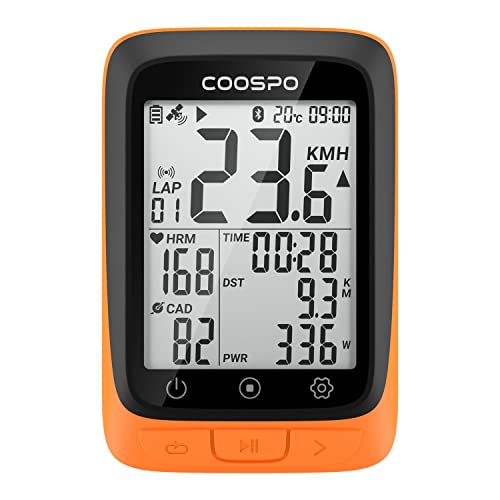
Best Budget Strava Sync – COOSPO BC107
The COOSPO BC107 is a compact option for cyclists seeking bike computers with Strava syncing at a lower-cost-oriented feature set. It records GPS rides, supports ANT+ sensors, and transfers activity files to Strava through the CoospoRide app.
Best For: Budget-conscious riders who want straightforward GPS tracking and app-based Strava uploads.
Pros:
- Compact 2.4-inch LCD with a lightweight, robust housing.
- Supports GPS and Beidou positioning, with an option to disable GPS for indoor riding.
- Works with ANT+ heart-rate, speed, cadence, and power sensors.
- CoospoRide can sync recorded .fit files to Strava.
Cons:
- The computer itself supports ANT+ sensors rather than Bluetooth sensor connections.
- Strava uploads require the CoospoRide app; direct USB uploading to Strava is not supported.
- An extension long front mount must be purchased separately if needed.
The BC107 keeps the essentials simple: GPS ride recording, ANT+ sensor compatibility, and phone-assisted Strava syncing in a small handlebar unit.
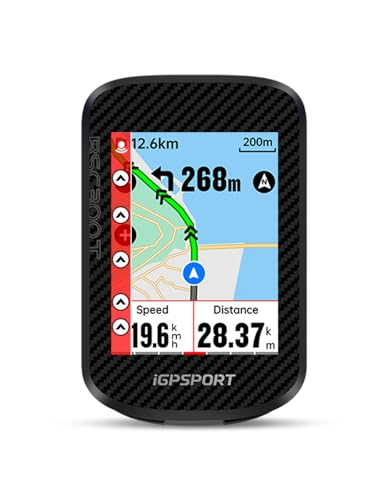
Best for Offline Maps – iGPSPORT BSC300T
The iGPSPORT BSC300T suits riders comparing bike computers with Strava sharing, offline maps, and broad sensor support. Its touchscreen and buttons provide access to worldwide offline maps, route prompts, off-course warnings, and more than 130 riding data fields.
Best For: Road, mountain, and e-bike riders who want offline navigation and flexible device connectivity.
Pros:
- Supports worldwide offline map downloads, route previews, and turn prompts.
- Offers more than 130 data fields, including speed, grade, cadence, and temperature.
- Shares analyzed ride data to Strava and Komoot through the iGPSPORT app.
- Supports both ANT+ and Bluetooth 5.0 devices, including sensors, e-bikes, and smart trainers.
Cons:
- The 2.4-inch display is smaller than the BSC500’s screen.
- A Type-C charging cable is not included.
- Its numerous features may require more setup than a basic GPS computer.
With offline maps, real-time tracking, e-bike support, and Strava sharing, the BSC300T is a versatile middle-ground choice for riders who want navigation without relying on continuous phone access.
Best for Long Battery Life – CYCPLUS M1
The CYCPLUS M1 is a practical pick among bike computers with Strava integration, especially for riders who value extended runtime and included sensors. It combines a 2.9-inch sunlight-visible LCD with GPS tracking, ANT+ and Bluetooth connectivity, and app-based Strava synchronization.
Best For: Long-distance riders who want extended battery life and a speed/cadence sensor bundle.
Pros:
- Offers more than 60 hours of stated working time.
- 2.9-inch glare-free LCD includes automatic backlighting for day and night visibility.
- Includes a speed and cadence sensor that can switch between the two modes.
- Records ride metrics such as speed, cadence, heart rate, power, route, and altitude, then syncs them to Strava through CYCPLUSFit.
Cons:
- The included mount is designed for 31.8 mm handlebars.
- It uses an IPX6 rating, rather than the higher IPX7 rating offered by some alternatives.
- The first-use setup requires setting the time zone before normal operation.
The M1 stands out for endurance-oriented riding, pairing a long-running battery with bundled speed and cadence tracking and a clear LCD suited to changing light conditions.
Best Color Navigation Pick – COOSPO CS600 GPS Bike Computer
For riders comparing bike computers with Strava, the COOSPO CS600 stands out with a responsive 2.4-inch color touchscreen, built-in route navigation, and automatic ride-data syncing to Strava and TrainingPeaks. Its GPS/GLONASS tracking, customizable dashboards, and 36-hour battery make it suited to both daily rides and longer adventures.
Best For: Cyclists who want color navigation, touchscreen controls, and broad sensor connectivity.
Pros:
- Syncs ride data to Strava and TrainingPeaks through the COOSPORIDE app.
- Color touchscreen with auto-backlight helps make routes and metrics easier to view.
- Supports breadcrumb route navigation, bike radar, ANT+, and Bluetooth accessories.
- Offers IPX7 waterproofing and up to 36 hours of battery life.
Cons:
- Additional cadence, heart-rate, and power sensors are sold separately.
- Touchscreen controls may be less convenient when wearing bulky gloves.
The CS600 is a feature-rich choice for riders who value on-device navigation and Strava syncing. It is especially appealing if you want a customizable training display without giving up weather protection or extended battery life.
Best Lightweight Long-Battery Pick – CYCPLUS G1 Wireless GPS Bike Computer
The CYCPLUS G1 is a compact option for cyclists who want straightforward GPS ride tracking and long runtime. While its supplied features focus on core ride data rather than a stated Strava integration, its 70-gram design, automatic backlight, and claimed working time beyond 55 hours make it practical for extended rides.
Best For: Riders prioritizing low weight, simple operation, and long battery life.
Pros:
- Lightweight 70-gram body takes up little handlebar space.
- Tracks route, time, distance, altitude, and related ride information with GPS.
- Automatic backlight improves visibility in bright or low-light conditions.
- Offers IPX6 water resistance and a two-year warranty.
Cons:
- The supplied notes do not specify Strava syncing or ANT+/Bluetooth sensor support.
- Its 2-inch display and button interface are less feature-rich than larger navigation computers.
Choose the G1 when portability and endurance matter more than advanced navigation or a connected training ecosystem. It provides a focused set of GPS metrics in a small, weather-resistant package.
Best Battery-and-Navigation Value – COOSPO CS500 GPS Bike Computer
For bike computers with Strava, the COOSPO CS500 offers a practical balance of route guidance, sensor support, and long battery life. It records rides with multi-system GPS, provides preloaded maps and turn prompts, and connects through the COOSPORIDE app for sharing data to Strava and TrainingPeaks.
Best For: Riders who want turn guidance, radar compatibility, and a long-lasting training computer.
Pros:
- Syncs and shares ride data to Strava and TrainingPeaks through the COOSPORIDE app.
- Uses GPS, Beidou, GLONASS, GALILEO, and QZSS for route and speed tracking.
- Provides preloaded maps, turn prompts, and a customizable 140-plus-metric display.
- Supports ANT+/Bluetooth sensors, bike radar, and up to 45 hours of battery life.
Cons:
- The 2.6-inch LCD uses buttons rather than a touchscreen.
- Its full feature set may be more than casual riders need.
The CS500 is a strong all-around pick for riders who want Strava sharing without sacrificing navigation or battery endurance. Its radar and sensor compatibility also leave room to build a more connected cycling setup over time.
Best Navigation Pick – iGPSPORT BiNavi Touchscreen Bike Computer
If you want bike computers with Strava route support plus a more feature-rich navigation experience, the iGPSPORT BiNavi is a strong option. Its 3.5-inch color touchscreen supports imported Strava routes, turn-by-turn route planning, automatic rerouting, climb previews, and music control when paired with a phone.
Best For: Riders who want touchscreen navigation, climb planning, and extensive connected features for longer or more complex rides.
Pros:
- Imports routes from Strava, Komoot, and other sources.
- Dual-band GPS and five-satellite-system support can improve positioning accuracy.
- Offers up to 35 hours of battery life, music control, and climb-planning tools.
- Supports ANT and Bluetooth connections, with 32GB of storage.
Cons:
- Its larger feature set may be more than casual riders need.
- Route importing and music control require app or phone pairing for the relevant functions.
The BiNavi stands out when navigation is the priority. It costs some simplicity compared with basic cycling computers, but the touchscreen, rerouting, training analysis, and long battery life make it a versatile choice for data-focused riders.
Best Battery Value – iGPSPORT BSC100S GPS Bike Computer
The iGPSPORT BSC100S is a straightforward choice among bike computers with Strava support. It records more than 40 riding metrics, connects to the iGPSPORT app for analysis and sharing to Strava, and uses a clear 2.6-inch anti-glare display with up to 40 hours of battery life.
Best For: Riders who want dependable ride tracking, long battery life, and sensor connectivity without built-in route navigation.
Pros:
- Shares recorded ride data to Strava through the iGPSPORT app.
- Up to 40 hours of battery life supports extended rides.
- Provides more than 40 metrics, including speed, cadence, grade, and temperature.
- ANT+ and Bluetooth support works with compatible speed, cadence, and heart-rate sensors.
Cons:
- Does not list built-in route navigation or turn guidance.
- The package notes that a Type-C charging cable is not included.
- Its button-operated monochrome LCD is less feature-rich than a touchscreen model.
The BSC100S focuses on the essentials: accurate GPS recording, broad sensor compatibility, and unusually long battery life. It is a practical fit for riders who mainly want reliable data to review and share on Strava.
Best Budget Navigation – iGPSPORT BSC200S GPS Bike Computer
For riders comparing bike computers with Strava route support, the iGPSPORT BSC200S offers navigation without moving to a larger touchscreen unit. It can import routes from Strava, Ride with GPS, and Komoot, while providing turn and off-course reminders, customizable data pages, and more than 100 riding metrics.
Best For: Cyclists who want affordable route guidance, broad data tracking, and a compact, weather-resistant computer.
Pros:
- Imports third-party routes from Strava, Ride with GPS, and Komoot.
- Provides turn reminders, off-course alerts, direction guidance, and Back to Start navigation.
- Offers more than 100 riding data fields and stores up to 400 hours of ride data.
- IPX7 waterproofing and a sunlight-readable color display suit varied riding conditions.
Cons:
- Battery life is rated at up to 25 hours, less than the BSC100S.
- The 2.4-inch display and button controls are smaller and less interactive than a touchscreen.
- The package notes that a Type-C charging cable is not included.
The BSC200S is a well-balanced option for riders who want route navigation and detailed ride data in a compact format. Its 25-hour battery is sufficient for many rides, while IPX7 protection and radar-light compatibility add everyday practicality.
How We Picked These Bike Computers with Strava
We focused on GPS bike computers that support wireless ride tracking and offer a practical path to Strava integration, typically through Bluetooth, ANT+, a companion smartphone app, or compatible cycling platforms. The selected models cover several use cases, from simple speed and distance recording to touchscreen mapping, route navigation, training metrics, and e-bike compatibility.
We also considered display size, control method, waterproofing, battery capacity, positioning reliability, sensor support, and overall portability. Because Strava features can depend on the manufacturer’s app and phone connection, buyers should verify current app compatibility before purchasing.
Quick Comparison
- Best for advanced navigation: Choose a touchscreen model with maps, rerouting or off-course alerts, and route guidance.
- Best for sensor-heavy training: Look for Bluetooth and ANT+ support for heart-rate monitors, cadence sensors, speed sensors, and power meters.
- Best for simplicity: A compact GPS computer with an LCD display is usually easier to operate and more affordable.
- Best for long rides: Prioritize a large battery, efficient screen, and dependable automatic recording.
- Best for wet conditions: Select a model with a strong water-resistance rating and secure physical controls.
Key Buying Factors for Bike Computers with Strava
Strava Sync and Connectivity
Confirm how rides transfer to Strava. Most computers record data locally and sync through a phone app after the ride, while some offer more direct connectivity. Bluetooth and ANT+ support are valuable if you use external sensors or want more accurate training data than GPS alone can provide.
Navigation and Screen Design
Turn-by-turn guidance, offline maps, route imports, climb information, and off-course warnings are useful for unfamiliar roads. Touchscreens can make map interaction easier, but physical buttons may work better with gloves, rain, or rough roads. Compare screen brightness and size with the computer’s weight and mounting footprint.
Battery Life and GPS Performance
Battery claims vary by screen brightness, navigation use, sensor connections, and GPS settings. Choose more capacity than your typical ride requires, particularly for touring or endurance events. Multi-constellation positioning can improve tracking in challenging areas, but it may also consume more power.
Weather Resistance and Compatibility
Waterproof ratings help protect against rain and spray, but they do not replace careful port-cover maintenance. Check mount compatibility, charging requirements, smartphone support, and whether the unit works with your existing cadence, heart-rate, power, or e-bike systems.
Who Should Buy Which Bike Computers with Strava?
Casual riders should choose a straightforward GPS computer that displays speed, distance, time, and route data without adding unnecessary complexity. Fitness-focused cyclists will benefit from Bluetooth and ANT+ sensor support, customizable data pages, and reliable Strava synchronization. Explorers and commuters should prioritize mapping, route guidance, readable screens, and weather resistance. Touring and endurance riders should favor long battery life, dependable GPS recording, and controls that remain usable in changing conditions. For frequent navigation, a larger touchscreen model is worth considering; for minimal weight and cost, a compact LCD unit may be the better fit.