Indoor bike rollers can turn an ordinary bicycle into a practical training setup without requiring a permanent gym-style installation. The right model can improve balance, cadence, and consistency while folding away when your ride is over.
We selected 10 options spanning classic rollers, magnetic trainers, foldable stands, and higher-end systems. Use the guide below to compare stability, resistance, wheel compatibility, noise, portability, and overall value before buying.
Best 10 Bike Rollers for Indoor Training Picks for 2026
Stable Classic

- Tapered rollers help center the wheels.
- No power required or maintenance needed.
- Folds for storage and fits 26–29-inch wheels.
Best For: Simple, stable indoor riding without powered resistance
Adjustable Training
Elite Arion Mag Folding Rollers

- Three levels of magnetic resistance.
- Folds for compact storage.
- Compatible with Rouvy and Kinomap.
Best For: Structured indoor workouts in space-conscious home gyms
Smart Roller Platform
Wahoo KICKR ROLLR Indoor Trainer

- Five magnetic resistance settings.
- Carbon-steel construction supports a 250-pound load.
- Includes an AC power adapter.
Best For: Riders wanting a sturdy trainer with adjustable resistance
Portable Fork-Mount

- Five levels of magnetic resistance.
- Fits 16–29-inch wheels and multiple axle types.
- Foldable aluminum frame suits travel and storage.
Best For: Portable indoor training across compatible road bikes
Balance-Focused Roller Trainer
Compact Indoor Cycling Practice

- Parabolic rollers help center the tire
- Portable design with storage case
- Requires a balance trainer, sold separately
Best For: Skill-focused riders needing portable indoor practice
Adjustable Magnetic Trainer
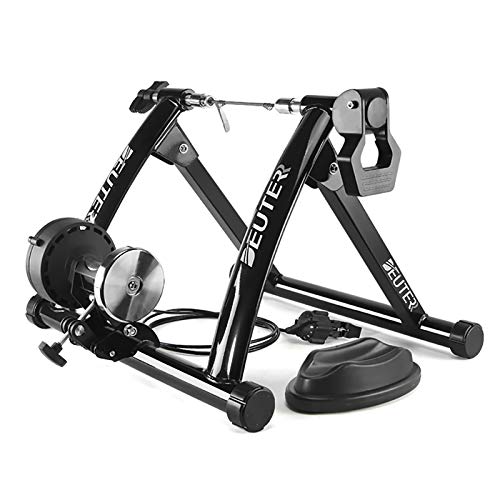
- Six handlebar-controlled resistance levels
- Fits 26-29 inch and 700C wheels
- Folds for storage and includes a riser block
Best For: Adjustable indoor workouts on road or mountain bikes
Foldable Self-Centering Rollers
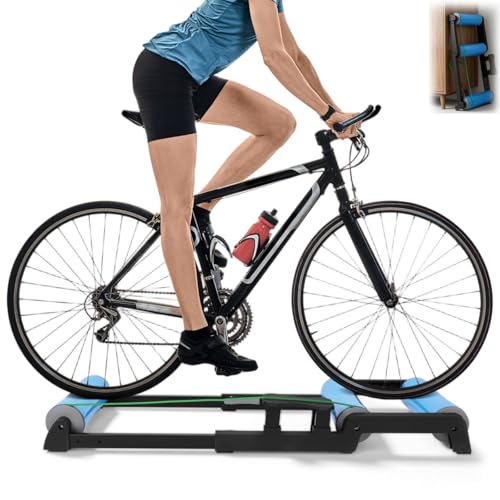
- Tapered rollers help keep wheels centered
- Seven-position fit for 24-28 inch wheels
- Folds for storage and includes a belt tensioner
Best For: Quiet balance practice in apartments or shared homes
Best Magnetic Trainer for Adjustable Resistance
Sportneer Indoor Cycling Trainer

- Six magnetic resistance levels with handlebar remote
- Fits many 26–28-inch and 700C bikes
- Stable frame with riser block and anti-slip feet
Best For: Riders wanting adjustable resistance and a stable rear-wheel trainer
Best Foldable Parabolic Rollers
ROCKBROS Adjustable Bike Rollers

- Parabolic design helps improve stability
- Adjusts for 16–29-inch bike wheels
- Folds flat and weighs 6.5 kilograms
Best For: Portable indoor balance and cadence practice across several bike types
Best Fluid Roller Stand for Quiet Training

- Fluid resistance is designed for quieter operation
- Adjustable front wheel bracket for many bikes
- Foldable aluminum frame supports easy storage
Best For: Indoor training in apartments, condos, and other shared spaces
Stable Classic – Garmin TacX Antares Rollers
For riders who want straightforward bike rollers for indoor training, the Garmin TacX Antares emphasizes wheel tracking and simple setup. Its tapered rollers help keep the bike centered, while the folding frame makes storage easier.
Best For: Road and mountain-bike riders seeking maintenance-free rollers without powered resistance.
Pros:
- Tapered rollers improve wheel centering and stability.
- Requires no power and is maintenance free.
- Fits 26- to 29-inch wheels.
- Folds to approximately 31.5 × 18.5 × 5.31 inches.
Cons:
- Offers no powered resistance adjustment.
- Its maximum footprint can extend to 53 inches long.
The Antares is a practical choice when balance support, broad wheel compatibility, and easy storage matter more than app-connected features or electronically controlled workouts.
Adjustable Training – Elite Arion Mag Folding Rollers
The Elite Arion Mag adds manually adjustable magnetic resistance to bike rollers for indoor training. Three resistance levels, a folding frame, and compatibility with Rouvy and Kinomap make it suited to structured sessions in smaller home spaces.
Best For: Riders who want compact rollers with selectable resistance for endurance, interval, and power workouts.
Pros:
- Three manual magnetic-resistance levels.
- Central selector allows resistance changes while riding.
- Folding dimensions help simplify storage.
- Works with Rouvy and Kinomap apps.
Cons:
- Resistance adjustment is manual rather than electronically controlled.
- The frame uses plastic and composite materials.
With its compact fold and adjustable magnetic load, the Arion Mag offers more workout control than basic unpowered rollers while remaining relatively simple to operate.
Smart Roller Platform – Wahoo KICKR ROLLR Indoor Trainer
The Wahoo KICKR ROLLR is a powered indoor trainer platform with magnetic resistance and five settings. Its carbon-steel construction and 250-pound load capacity make it a substantial option for riders comparing bike rollers for indoor training.
Best For: Riders who prioritize a sturdy, adjustable magnetic trainer platform.
Pros:
- Provides five magnetic resistance settings.
- Carbon-steel frame is designed for a sturdy setup.
- Supports loads up to 250 pounds.
- Includes the trainer, AC power adapter, and owner’s manual.
Cons:
- At 25 kg, it is relatively heavy to move.
- The supplied notes identify mountain-bike compatibility only.
The KICKR ROLLR makes sense for buyers who want multiple resistance settings and a robust frame, but its weight may matter if the trainer must be stored or relocated frequently.
Portable Fork-Mount – CXWXC GT-05 Magnetic Trainer
The CXWXC GT-05 is a portable fork-mount option for bike rollers for indoor training, with five magnetic resistance levels and a foldable aluminum frame. Its included 9 mm quick-release adapter and support for several thru-axle sizes broaden fit across compatible bikes.
Best For: Riders who need a compact, travel-friendly trainer with adjustable resistance and broad wheel compatibility.
Pros:
- Fits 16- to 29-inch wheels.
- Supports 9 mm quick-release and 12×100, 15×100, and 15×110 mm thru-axles.
- Five magnetic resistance levels with a control knob.
- Foldable aircraft-grade aluminum frame is designed for portability.
Cons:
- The manufacturer notes some front-end sway during riding.
- Thru-axle installation requires careful adapter alignment.
- The supplied listing identifies road-bike compatibility.
The GT-05 is appealing for riders who value portability and axle compatibility, though those requiring maximum front-end stability should consider the stated sway before buying.
Balance-Focused Roller Trainer – Compact Indoor Cycling Practice
This roller trainer is designed for cyclists who want to keep balance, technique, and endurance sharp indoors. It works with road, mountain, and BMX bikes when used with the required balance trainer, which is not included.
Best For: Riders prioritizing handling skills, smooth pedaling, and portable indoor training.
Pros:
- Parabolic polymer rollers help keep the tire centered while minimizing tire wear and noise.
- Requires no tire removal or complicated adjustments once the balance trainer is available.
- Leveling feet, a metal frame, and a stated 300-pound load capacity support stable use.
- Lightweight design includes a canvas storage case for transport.
Cons:
- The required balance trainer is not included.
- Road and BMX bike use requires spacers.
This is a practical choice for skill-focused riders who value quick setup and portability, but account for the additional balance-trainer requirement before buying.
Adjustable Magnetic Trainer – Six-Level Bike Stand
This magnetic bike trainer offers a stationary alternative when weather, traffic, or limited daylight keeps you indoors. It fits 26- to 29-inch wheels, including 700C, and provides six resistance levels for adjustable workouts.
Best For: Road and mountain-bike riders who want adjustable resistance and a folding indoor stand.
Pros:
- Six resistance settings can be changed from the handlebars.
- Fits 26- to 29-inch wheels, including 700C sizes.
- Folding design, quick clamp, and included front-wheel riser block simplify setup and storage.
- Strong alloy-steel construction has a stated 330-pound load capacity.
Cons:
- Rough mountain-bike tires may produce noticeable noise and vibration.
- The trainer is less suitable for riders seeking the balance practice of true rollers.
Choose this model if resistance control matters more than free-rolling balance work. Smooth tires and a mat may help reduce indoor vibration.
Foldable Self-Centering Rollers – Quiet Multi-Bike Trainer
These bike rollers for indoor training use tapered, self-centering rollers to support balance and pedal-stroke practice. The foldable frame fits road, mountain, and city bikes with 24- to 28-inch wheel diameters and adjusts across seven positions.
Best For: Riders wanting a compact, quiet roller setup for shared homes or apartments.
Pros:
- PP rollers are designed for smooth, low-noise operation.
- Conical rollers help keep the bike centered and reduce tire wear.
- Seven quick-adjust positions support multiple bike types without tools.
- Steel construction, nonslip feet, folding storage, and an included belt tensioner add practicality.
Cons:
- Wheel compatibility is limited to 24- through 28-inch diameters.
- The product details list aluminum for both material and frame, while the features describe a steel frame; verify construction details before purchase.
This roller is a versatile option when quiet operation, self-centering support, and easy storage are priorities. Its seven-position adjustment makes it useful for households with more than one compatible bike.
Best Magnetic Trainer for Adjustable Resistance – Sportneer Indoor Cycling Trainer
For riders who want bike rollers for indoor training with selectable workout intensity, the Sportneer trainer uses magnetic resistance and a handlebar-mounted remote. It fits many 26–28-inch and 700C bikes, includes a front wheel riser block, and is designed for stable home use.
Best For: Road and mountain-bike riders who want adjustable resistance and a conventional rear-wheel trainer setup.
Pros:
- Six resistance levels can simulate easier rides and steeper climbs.
- Fits many bikes with 26–28-inch or 700C wheels; a separate thru-axle version is available.
- Wide base, low center of gravity, and five adjustable anti-slip feet support stability.
- Quick-release lever, skewer, and front wheel block simplify setup.
Cons:
- Compatibility depends on the bike’s rear axle dimensions and version selected.
- Noise varies by tire material and tread; slick or road tires are recommended.
- It is a relatively heavy unit at 19.3 pounds.
This is a practical choice when resistance control matters more than the balance practice offered by open rollers. Its stable steel frame and broad compatibility make it a versatile indoor training stand, provided your bike matches the axle requirements.
Best Foldable Parabolic Rollers – ROCKBROS Adjustable Bike Rollers
The ROCKBROS stand is a strong match for shoppers specifically looking for bike rollers for indoor training. Its three aluminum rollers use a parabolic design to help keep the bike centered, while the adjustable frame accommodates several wheel sizes and folds for storage.
Best For: Cyclists who want portable rollers for balance, cadence, and indoor riding practice across multiple bike types.
Pros:
- Parabolic rollers are designed to improve stability compared with straight rollers.
- Adjustable front holes accommodate 16–29-inch wheels, including MTB, road, and folding bikes.
- Folds flat into a lightweight 6.5-kilogram design for storage and carrying.
- Sealed bearings support a smoother roller operation.
Cons:
- The notes identify one resistance setting rather than a selectable resistance range.
- Roller training requires more balance and bike control than a fixed trainer.
- Its stated load capacity is 250 pounds, so heavier riders should verify suitability.
Choose this model if compact storage and a more realistic open-roller experience are priorities. The parabolic shape adds confidence, but riders should still expect to practice balance and control compared with a fixed-position stand.
Best Fluid Roller Stand for Quiet Training – Home Use Bike Trainer Stand
This home-use trainer is aimed at cyclists seeking bike rollers for indoor training in a quieter shared living space. Its aluminum frame converts a mountain or road bike into a fixed indoor setup, and the adjustable front wheel bracket supports a range of bikes.
Best For: Apartment, condo, or home users who value low-noise training and foldable storage.
Pros:
- Fluid resistance is described as quieter than magnetic training options.
- Adjustable front wheel bracket supports most types of mountain and road bikes.
- Foldable aluminum frame is easier to store and carry.
- Includes a replacement quick release for attaching the bike to the trainer.
Cons:
- The supplied notes do not specify a resistance-level adjustment range.
- Smooth tires are recommended to reduce vibration during training.
- A carpet underneath may be needed for additional vibration control.
This trainer makes the most sense for all-season conditioning when reduced noise and easy storage are important. Its fixed-position format offers a stable indoor ride, while the tire and floor recommendations may matter in shared or vibration-sensitive spaces.
How We Picked These Bike Rollers for Indoor Training
We focused on the features that matter most during repeated indoor rides: frame stability, roller construction, resistance control, compatibility with common road and mountain-bike wheels, setup simplicity, storage, and expected noise. The selection includes traditional free-rolling designs for balance practice as well as fixed magnetic trainers for riders who prefer a more secure feel.
Because product listings can vary by seller and configuration, confirm the stated wheel range, axle or skewer requirements, resistance controls, and included accessories before ordering. A front-wheel riser, remote resistance unit, or compatible adapter may not be included with every package.
Quick Comparison
| Best For | Look For | Recommended Type |
|---|---|---|
| Balance and smooth pedaling | Three rollers, parabolic shape, adjustable width | Classic roller system |
| Structured resistance workouts | Multiple resistance levels or a handlebar control | Magnetic trainer stand |
| Simple storage | Folding frame and retractable or compact rollers | Foldable trainer |
| Mixed bikes and wheel sizes | Broad compatibility and adjustable supports | Adjustable stand or roller |
Key Buying Factors for Bike Rollers for Indoor Training
Roller Style and Stability
Traditional rollers require you to balance the bicycle while riding, which makes them useful for cadence, line control, and technique. Parabolic rollers help guide the tires toward the center. Fixed magnetic stands hold the rear wheel in place and are generally easier for beginners or high-effort intervals.
Resistance and Workout Control
Basic rollers may rely mostly on gearing and cadence. Magnetic models typically offer several resistance levels, while premium systems may add electronically controlled resistance or broader training-app compatibility. Choose adjustable resistance if you plan to perform interval workouts rather than easy spinning only.
Fit, Axles, and Wheel Compatibility
Check whether the trainer supports your tire width, wheel diameter, axle standard, and bike type. Listings mentioning 26- to 29-inch wheels or 700C are common, but that does not guarantee compatibility with every tire or thru-axle setup. Measure your bike and verify the supplied hardware.
Noise, Footprint, and Storage
Aluminum rollers and magnetic resistance units can produce noticeable drivetrain and tire noise, especially at higher speeds. A rigid frame, level floor, and correct tire pressure help reduce vibration. For small spaces, prioritize folding legs, retractable rollers, and a manageable folded size.
Who Should Buy Which Bike Rollers for Indoor Training?
Choose classic parabolic rollers if you want to refine balance, cadence, and bike handling while enjoying a natural ride feel. Choose a magnetic trainer stand if stability and controlled resistance matter more than balance practice. Choose a foldable or retractable model if you need to store the trainer after every session. Riders with multiple bicycles should prioritize wide fit adjustment and clearly stated axle compatibility.
Whichever style you choose, place it on a firm, level surface, inspect the frame before each ride, and keep enough clearance around the bicycle to step off safely. A fan, towel, and dedicated indoor tire can also make regular training more comfortable and help protect your equipment.