Finding room for explosive training can be difficult when your home gym occupies a corner, spare room, or apartment. The best plyometric boxes for small spaces deliver useful height options and stable support without creating a permanent obstacle.
We compared these 10 options by footprint, construction, surface grip, height versatility, and storage practicality so you can choose a box that fits both your workouts and your available floor space.
Best 10 Plyometric Boxes for Small Spaces Picks for 2026
Compact Steel Pick
Rage Fitness 12-Inch Steel Plyo Box

- Compact 12-inch platform for limited floor space
- Steel frame supports up to 560 pounds
- Pre-assembled with rubber anti-slip surfaces
Best For: Low-height step-ups and compact home gyms
Soft Adjustable Pick
BalanceFrom 3-in-1 Foam Plyo Box

- Rotates between 16-, 20-, and 24-inch heights
- High-density foam offers softer impact
- Lightweight and textured for portable home training
Best For: HIIT and progressive training with softer landings
Padded Stability Pick

- Three height options from 12 to 16 inches
- Wooden core adds stability beneath EVA padding
- Non-slip vinyl surface and 450-pound capacity
Best For: Versatile cushioned training in a home gym
Low-Profile Wood Pick
CAP Barbell 3-in-1 Plyometric Box

- Rotates to 12-, 14-, and 16-inch heights
- Interlocking engineered-wood construction
- Textured surface and built-in carry handles
Best For: Low-height adjustable training with easy repositioning
Best Foam Option
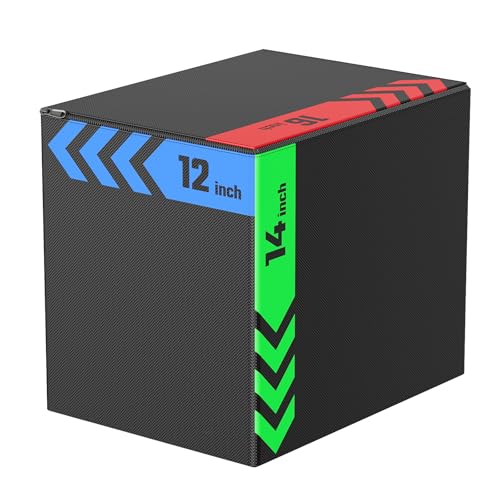
- Compact 12 x 14 x 16-inch footprint
- Three heights with impact-cushioning foam
- Lightweight, grippy, and portable
Best For: Home users wanting softer landings and easy storage
Best High-Capacity Pick
Amazon Basics 3-in-1 Wooden Plyo Box

- Compact 14 x 12 x 16-inch design
- Three marked heights for progression
- 450-pound wooden construction
Best For: Indoor home gyms needing a sturdy, high-capacity box
Best Stable Platform

- Stable trapezoidal welded steel frame
- 500-pound stated weight capacity
- Textured top and rubber feet for grip
Best For: Users prioritizing rigid stability at a 12-inch height
Best Soft-Foam Pick

- Three height options in one flip-style box
- Soft EPE foam and non-slip PU cover
- Fully assembled and weighs 5.9 pounds
Best For: Compact home gyms prioritizing portability and cushioned landings
Best Wooden Option
Fitvids Non-Slip Wooden Plyo Box

- Three height options across multiple size choices
- Non-slip plywood platform with puzzle joints
- 450-pound capacity and two-year warranty
Best For: Users wanting a rigid, durable box for compact home gyms
Best Lightweight 16–24-Inch Box

- Flips between 16-, 20-, and 24-inch heights
- Seven-pound EPE foam design cushions landings
- Tear-resistant PU cover wipes clean quickly
Best For: Portable home workouts using moderate jump and step heights
Compact Steel Pick – Rage Fitness 12-Inch Steel Plyo Box
For shoppers comparing plyometric boxes for small spaces, this compact steel platform offers a fixed 12-inch height and a footprint of about 12.5 by 12.5 inches. It arrives pre-assembled, making it a straightforward choice for home workouts where quick setup and easy storage matter.
Best For: Low-height step-ups, beginner box jumps, conditioning, and compact home gyms.
Pros:
- Compact footprint and fixed 12-inch height suit space-conscious setups.
- Heavy-gauge steel frame supports up to 560 pounds.
- Rubber top and bottom help resist slipping, wobbling, and tipping.
- Arrives constructed and ready to use.
Cons:
- Fixed height offers less progression than adjustable boxes.
- Steel construction weighs 12 pounds and may be less forgiving than foam.
This is a practical small-space option when you want a sturdy, low platform without assembly. Its limited height is best suited to controlled step-ups and lower box-jump training rather than advanced jump progressions.
Soft Adjustable Pick – BalanceFrom 3-in-1 Foam Plyo Box
This foam box is a flexible choice for plyometric boxes for small spaces because one unit rotates between 16-, 20-, and 24-inch heights. Its lightweight design is easy to move and store, while the softer construction can make missed landings more forgiving.
Best For: Home HIIT, progressive jump training, agility drills, and users who prefer a softer landing surface.
Pros:
- Three height options support varied training and progression.
- High-density foam helps soften impact and reduce shin scrapes.
- Textured surface provides traction for jumps, landings, and step-ups.
- Lightweight 10-pound design is easy to reposition.
Cons:
- Its largest listed dimensions require more floor space than the smallest fixed boxes.
- Maximum recommended weight is 250 pounds.
The rotating 3-in-1 format gives this box useful versatility without requiring multiple platforms. Check the available floor area carefully, especially if you plan to use the 24-inch orientation in a compact room.
Padded Stability Pick – Yes4All 3-in-1 Soft Plyo Box
For a compact training station, the Yes4All combines three height options with a wooden core, EVA foam padding, and a non-slip vinyl cover. Its 16-by-14-by-12-inch listed dimensions make it a useful fit for plyometric boxes for small spaces while still supporting several exercises.
Best For: Box jumps, step-ups, push-ups, and home users who want adjustable heights with a cushioned surface.
Pros:
- Three orientations provide 12-, 14-, and 16-inch training heights.
- Wooden core and layered construction provide a stable platform.
- EVA foam and vinyl covering cushion contact and offer a non-slip, waterproof surface.
- Supports up to 450 pounds according to the supplied specifications.
Cons:
- The padded construction may be less compact to store than a small steel step.
- Only a 30-day return period and one-year warranty are listed.
This model balances adjustability, cushioning, and a relatively compact footprint. It is especially practical when the box must handle varied home exercises rather than jumps alone.
Low-Profile Wood Pick – CAP Barbell 3-in-1 Plyometric Box
The CAP Barbell offers three low training heights—12, 14, and 16 inches—making it a space-conscious option among plyometric boxes for small spaces. Its engineered-wood construction, integrated handles, and interlocking panels are designed for repeat home-gym use.
Best For: Low-to-moderate box jumps, step-ups, agility drills, and users who need easy repositioning.
Pros:
- Three height options allow gradual progression in a compact format.
- Interlocking panels and countersunk screws create a secure assembled platform.
- Textured surface improves traction during training.
- Built-in carry handles make repositioning easier.
Cons:
- Maximum recommended weight is 300 pounds.
- Engineered wood may be less forgiving on contact than a padded foam box.
This is a sensible pick for users who want adjustable low heights without a tall, bulky platform. The carry handles are particularly useful when the box needs to be moved between exercises or stored after training.
Best Foam Option – Papababe 3-in-1 Foam Jump Box
For shoppers seeking plyometric boxes for small spaces, the Papababe combines three training heights in a compact foam design. Its 12 x 14 x 16-inch format supports jumps, step-ups, and squats while remaining lightweight enough to reposition around a home gym.
Best For: Home users who prioritize portability, impact cushioning, and adjustable heights.
Pros:
- 3-in-1 design provides 12-, 14-, and 16-inch training heights.
- Heavy foam construction cushions impact and weighs about 15 pounds.
- Anti-slip, sweat-resistant 1000D Oxford surface supports secure workouts.
- Supports up to 200 pounds and includes a one-year manufacturer warranty.
Cons:
- Its 200-pound capacity is lower than the wooden and steel alternatives.
- Foam construction may be less suitable for users seeking a rigid platform.
This is a practical small-space choice when easy handling and softer landings matter more than maximum load capacity. Rotate the box to select a height, then move it aside quickly when the workout is over.
Best High-Capacity Pick – Amazon Basics 3-in-1 Wooden Plyo Box
The Amazon Basics wooden box is a compact option for plyometric boxes for small spaces, with a 14 x 12 x 16-inch size and three clearly marked heights. Its rigid construction and 450-pound capacity suit box jumps, step-ups, dips, and conditioning work in an indoor home gym.
Best For: Beginners through advanced users who want a sturdy, high-capacity wooden box with adjustable orientations.
Pros:
- Three usable heights: 12, 14, and 16 inches.
- Supports up to 450 pounds for a broad range of users.
- Built-in wide handles make repositioning easier.
- Pre-drilled and pilot holes simplify assembly, while sanded edges help prevent scratches.
Cons:
- Requires assembly before use.
- Designed primarily for indoor training and may be less forgiving than foam during landings.
Choose this model if stability and load capacity are more important than a soft surface. Its relatively compact footprint and integrated handles help it fit practical home-gym routines, though assembly and wooden construction make it less instantly portable than foam.
Best Stable Platform – VEVOR 12-Inch Steel Plyo Box
For plyometric boxes for small spaces, the VEVOR steel platform offers a 12-inch step height and an 18 x 18-inch footprint. Its trapezoidal welded frame, rubber feet, and textured top prioritize stability for box jumps, step-ups, push-ups, and strength training.
Best For: Users who want a low training height, steel durability, and a high stated weight capacity.
Pros:
- 500-pound maximum capacity accommodates demanding training sessions.
- Welded steel frame and trapezoidal design provide a stable platform.
- Textured silicone top and four rubber pads improve grip.
- Can be disassembled or stacked for storage and is straightforward to assemble.
Cons:
- Its 18 x 18-inch footprint is wider than the other listed options.
- Offers one 12-inch height rather than multiple training levels.
- Steel construction may provide less impact cushioning than foam.
This model makes sense when a secure, rigid platform is the priority and a slightly larger footprint is manageable. The single low height is approachable for step-ups and beginner box work, while the high capacity supports heavier training.
Best Soft-Foam Pick – Goplus 3-in-1 Foam Plyo Box
For shoppers comparing plyometric boxes for small spaces, this Goplus model is a flexible home-gym option that offers three heights in one compact, lightweight box. Flip it to switch between the available height configurations, then wipe the PU cover clean after training.
Best For: Home users who want a soft-sided, easy-to-move box for jumps, step-ups, dips, push-ups, and HIIT workouts.
Pros:
- Three height options selected by simply flipping the box.
- High-density EPE foam provides a softer landing with firm support.
- Non-slip, waterproof PU cover is easy to wipe clean.
- Arrives fully assembled and weighs 5.9 pounds.
Cons:
- Its maximum height depends on the selected configuration; the listed maximum is 30 inches.
- The 90-day warranty against manufacturer defects is relatively limited.
This is a practical choice when portability and impact cushioning matter more than a rigid wooden platform. Its 440-pound stated capacity and three-level design give it useful versatility for small-space training setups.
Best Wooden Option – Fitvids Non-Slip Wooden Plyo Box
Among plyometric boxes for small spaces, the Fitvids wooden platform offers a compact footprint with three height options and a rigid plywood construction. It requires assembly, but the puzzle-joint design and non-slip surface are intended to provide a stable base for repeated training.
Best For: Home-gym users who prefer a durable wooden box for jumps, strength work, and step exercises.
Pros:
- Three sizes are available, and each provides three height options.
- Non-slip surface helps support stability during jumps.
- Plywood construction with puzzle joints supports up to 450 pounds.
- Includes a two-year manufacturer warranty.
Cons:
- Assembly takes about 10 minutes.
- Wood construction is less impact-cushioned than a foam box.
- The supplied dimensions and size listing vary, so verify the selected configuration before ordering.
This model makes sense if you want a firm, traditional platform and are comfortable with brief assembly. Its compact listed footprint and adjustable heights can help consolidate several training uses into one piece of equipment.
Best Lightweight 16–24-Inch Box – Goplus Soft Foam Plyo Box
This Goplus box is well suited to small-space workouts because its 16-by-20-by-24-inch design provides three training heights without requiring tools or complicated setup. The seven-pound foam box can be moved between rooms while its wipe-clean PU cover handles regular HIIT and step-up sessions.
Best For: Users seeking a portable 16-, 20-, or 24-inch box for jumps, step-ups, split squats, dips, and agility training.
Pros:
- Three action heights are available by flipping the box.
- Dense EPE foam cushions landings and is designed to resist deforming.
- Tear-resistant, water- and sweat-resistant PU cover cleans quickly.
- Weighs seven pounds while supporting up to 352 pounds.
Cons:
- Its 352-pound capacity is lower than the other listed boxes in this roundup.
- The 90-day warranty against manufacturer defects is limited.
- It offers only the 16-, 20-, and 24-inch height range.
Choose this version when easy carrying and moderate-height training are priorities. It combines a compact, tool-free design with foam cushioning, making it convenient for multipurpose home workouts.
How We Picked the Best Plyometric Boxes for Small Spaces
We focused on equipment that can support box jumps, step-ups, low-impact conditioning, and other home workouts while remaining practical in a confined training area. Key considerations included overall footprint, usable height settings, stability, landing comfort, surface traction, durability, and how easily each box can be moved or stored.
Multi-height designs received particular attention because one compact box can replace several fixed-height platforms. We also considered whether a product arrives assembled, requires setup, or uses foam and padding to reduce the consequences of missed landings.
Quick Comparison
| Feature | What to Look For | Why It Matters in a Small Space |
|---|---|---|
| Height options | Two or three usable heights | Expands training variety without extra equipment |
| Construction | Steel, wood, foam, or hybrid core | Balances stability, weight, comfort, and storage |
| Base size | Compact but wide enough for your stance | Limits floor coverage without sacrificing confidence |
| Surface grip | Non-slip top and stable feet | Helps reduce sliding during jumps and step-ups |
Key Buying Factors for Plyometric Boxes for Small Spaces
Footprint and Storage
Measure the clear floor area before buying, including the landing zone in front of the box. A compact platform still needs room for safe movement. Handles, lighter construction, or a shape that can stand upright may make daily storage easier.
Height and Versatility
A three-in-one design is useful for progressive training, but only if each height is appropriate for your ability. Beginners may benefit from a low setting for step-ups before progressing to jumps. Do not choose maximum height over control and safe technique.
Stability and Landing Surface
Wood and steel generally offer a firm, responsive platform, while padded foam models can be more forgiving if your shins contact the box. Look for a broad base, non-slip covering, secure seams, and minimal rocking on your floor.
Noise, Weight, and Durability
Foam boxes are often quieter and easier to reposition, which can matter in apartments or shared homes. Wooden and steel models may feel more rigid and durable but can be heavier or louder. Match the material to your flooring, training intensity, and storage habits.
Who Should Buy Which Plyometric Boxes for Small Spaces?
Choose a foam box if impact comfort, quiet operation, and easy repositioning are priorities. Choose a wooden box if you want a firm, traditional platform for repeated jumps and step-ups. Choose steel when rigid construction and a ready-to-use platform matter most, provided the dimensions fit your room.
For most compact home gyms, a multi-height box offers the best balance of capability and space efficiency. Before each workout, place it on a level, clear surface and verify that the landing area is free of furniture, cords, and slippery mats.